
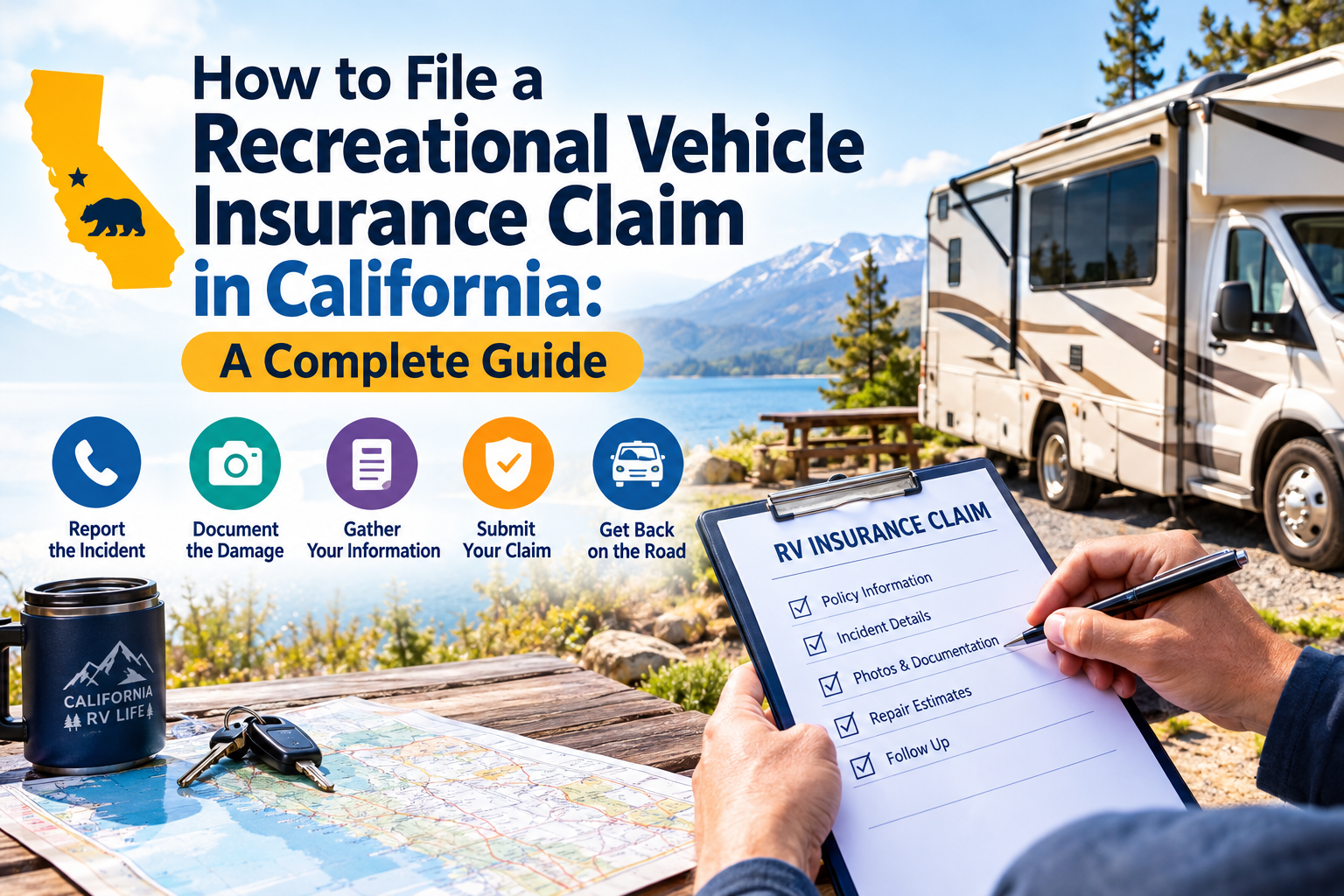
Owning a recreational vehicle (RV) gives you the freedom to explore California’s beaches, mountains, national parks, and scenic highways. However, accidents, theft, vandalism, storms, and other unexpected events can damage your RV and create significant financial stress. Understanding how to file a recreational vehicle insurance claim in California can help you navigate the process more confidently and avoid common mistakes.
Whether you own a motorhome, travel trailer, fifth-wheel camper, pop-up camper, or another type of recreational vehicle, knowing what to do after an incident is essential. Your insurance policy, the circumstances of the loss, and the documentation you provide can all affect how your claim is handled.
This guide explains how California RV insurance claims work, what documents you may need, how to communicate with your insurer, what happens during an inspection, and what steps you can take if your claim is delayed or denied.
1. What Is a Recreational Vehicle Insurance Claim?
A recreational vehicle insurance claim is a formal request to your insurance company for payment or other benefits following a covered loss involving your RV.
Depending on your policy, coverage may apply to damage caused by a collision, theft, fire, vandalism, certain weather events, or other covered incidents. Some policies may also include liability protection if you injure another person or damage someone else’s property while operating your motorhome.
For example, if your motorhome is damaged in a collision on a California highway, you may submit a collision claim if your policy includes that coverage. If your travel trailer is stolen from a storage facility, comprehensive coverage may help pay for the covered loss, subject to the policy terms and deductible.
However, not every incident is covered. Normal wear and tear, mechanical breakdowns, neglected maintenance, and certain types of water damage may be excluded or subject to specific limitations.
Before filing a claim, review your policy’s declarations page, coverage limits, deductibles, exclusions, and claim-reporting requirements.
2. Step One: Make Sure Everyone Is Safe
Your first priority after an RV accident or other emergency should be safety, not insurance paperwork.
If an accident occurs on a California road, move to a safe location if possible without creating additional danger. Check whether anyone is injured and call 911 when emergency medical assistance, fire services, or police are needed.
If your RV is blocking traffic, leaking fuel, or creating another hazard, stay at a safe distance and follow instructions from emergency responders.
For a theft, break-in, or vandalism incident, contact law enforcement when appropriate. Obtain the incident or police report number if one is available.
If your RV has suffered water intrusion, fire damage, or another ongoing problem, take reasonable steps to prevent additional damage when it is safe to do so. For instance, you may need to arrange temporary shelter or protect undamaged belongings from further exposure.
Do not put yourself at risk to protect the vehicle or collect evidence.
3. Step Two: Document the Damage and Gather Evidence
Good documentation can make the claims process easier by giving the insurer a clearer picture of what happened.
As soon as it is safe, collect as much relevant information as possible.
Take photographs and videos
Photograph the RV from several angles and capture close-up images of the damaged areas. If another vehicle was involved, document its damage and the surrounding scene when safe and appropriate.
Useful images may include:
- Damage to the RV’s exterior, roof, windows, tires, and undercarriage.
- Interior damage to furniture, appliances, flooring, and cabinetry.
- The accident location, road conditions, and visible hazards.
- Damaged personal belongings, if relevant to your coverage.
- The RV’s license plate and vehicle identification number (VIN).
Keep original files when possible, along with dates and any supporting notes.
Collect information from other parties
If another driver was involved, exchange contact and insurance information. Record the names of witnesses and obtain their contact details if they are willing to provide them.
Avoid arguing about fault or making speculative statements about responsibility. Describe the facts accurately and let the appropriate parties investigate.
Keep receipts and records
Save receipts for towing, emergency repairs, temporary accommodation, storage, and other expenses that may be relevant to your claim. Reimbursement depends on the policy and the circumstances, so do not assume every expense will be covered.
4. Step Three: Review Your California RV Insurance Policy
Before submitting a claim, understand what your insurance policy may cover.
RV insurance is not identical for every owner. Coverage depends on the vehicle, how it is used, the policy selected, and any endorsements or exclusions.
Common types of RV insurance coverage
Collision coverage: May pay for covered damage to your insured RV resulting from a collision with another vehicle or object, subject to the policy terms and deductible.
Comprehensive coverage: May cover certain non-collision losses, such as theft, fire, vandalism, or specified weather-related damage.
Liability coverage: May help cover bodily injury or property damage for which you are legally responsible, subject to the policy’s limits and conditions.
Uninsured or underinsured motorist coverage: May provide benefits for qualifying injuries caused by an uninsured or inadequately insured driver, depending on the coverage purchased and applicable law.
Personal effects coverage: May cover certain personal belongings kept inside the RV. Limits and exclusions vary.
Vacation liability coverage: May provide certain liability protection when an RV is used as a temporary residence or campsite, depending on the policy.
Emergency expense or roadside assistance coverage: May help with eligible expenses or services following a covered breakdown or incident, subject to specific terms.
Understand your deductible
A deductible is the amount you generally pay toward a covered claim before your insurer pays the remaining eligible amount.
For example, if an approved covered repair costs $6,000 and your applicable deductible is $1,000, the insurer may pay $5,000, assuming no other adjustments, limits, or policy provisions apply.
If the estimated repair cost is close to your deductible, consider asking the insurer about the financial implications before deciding how to proceed.
5. Step Four: Contact Your RV Insurance Company Promptly
Once you have addressed immediate safety concerns and gathered initial evidence, notify your insurance company as soon as reasonably possible.
Most insurers allow claims to be reported through a website, mobile application, telephone claims department, or insurance agent. Use the contact information provided in your policy documents or on the insurer’s official website.
When reporting your claim, be prepared to provide:
- Your policy number and contact information.
- The RV’s year, make, model, and VIN.
- The date, time, and location of the incident.
- A factual description of what happened.
- Information about other drivers or parties involved.
- Police report details, if applicable.
- Photographs and an initial damage estimate, if available.
Ask for your claim number and the assigned adjuster’s contact information. Also ask whether you should arrange towing, select a repair facility, or wait for an inspection before authorizing repairs.
Report the incident accurately, even if you are unsure whether your policy covers it. Your insurer can explain the next steps and evaluate the applicable provisions.
6. Step Five: Complete the Claim Forms and Submit Supporting Documents
After you report the incident, the insurer may ask you to complete claim forms and submit additional documentation.
Respond carefully and provide information that is accurate to the best of your knowledge. If you do not know an answer, explain that rather than guessing.
Depending on the type of claim, supporting documents may include:
- A completed claim form or incident statement.
- Photographs and videos of the damage.
- A police or accident report.
- Repair estimates and invoices.
- Towing and storage receipts.
- Purchase records or proof of ownership.
- Records of damaged personal property.
- Medical records for a relevant injury claim, when appropriate.
- Maintenance records if they are relevant to the cause of the damage.
For a stolen RV, the insurer may request additional ownership documents, keys, police information, and details about the vehicle’s last known location.
Keep copies of everything you submit. Maintain a record of when documents were sent, whom you spoke with, and any instructions or deadlines provided by the insurer.
7. Step Six: Cooperate With the Insurance Adjuster’s Investigation
After opening the claim, the insurance company generally assigns an adjuster or claims representative to investigate the incident and evaluate the loss.
The investigation may involve reviewing your policy, examining photographs, interviewing involved parties, obtaining reports, inspecting the RV, and assessing the estimated repair costs.
The adjuster may ask you to explain how the incident occurred or provide additional evidence. Answer questions honestly and distinguish between what you personally observed and what you believe may have happened.
What happens during an RV inspection?
The insurer may arrange an in-person inspection, use photographs for an initial estimate, or request an inspection by a repair facility.
Because RVs contain specialized systems, an inspection may need to consider more than exterior body damage. Depending on the incident, the evaluation could include the roof, slide-out mechanisms, plumbing, electrical systems, appliances, structural components, and interior water damage.
If the first estimate does not appear to account for all the damage, ask the adjuster how to submit supplemental repair estimates.
Hidden damage may become apparent only after repairs begin. Document newly discovered damage and contact the insurer before authorizing additional work when approval is required by your policy or claims process.
8. Step Seven: Get Repair Estimates and Understand the Settlement
Your insurer may recommend a repair facility or allow you to choose one. Ask whether the insurer has specific procedures for estimates, inspections, and supplemental approvals.
For complex motorhomes or specialized RV equipment, consider a repair shop experienced in the relevant vehicle type.
Review the estimate carefully. Check whether it addresses the damage identified during the inspection and whether any required parts, labor, painting, or system repairs appear to be missing.
If you disagree with the estimate, explain the reasons and provide supporting photographs or an independent estimate. Ask the insurer to review the differences.
How is an RV insurance claim paid?
The payment process depends on the coverage, policy language, repair arrangement, deductible, and whether another party is involved.
For a covered repair claim, the insurer may issue payment to you, the repair facility, or both. If your RV has an outstanding loan, the lender may have rights to claim payments or may be included on a settlement check.
If the RV is declared a total loss, the insurer will evaluate its value under the applicable policy. The settlement may depend on whether your policy uses actual cash value, an agreed-value arrangement, or another valuation method.
Do not assume that the amount you originally paid for your RV is the amount the insurer must pay. Review the valuation method, applicable limits, deductible, and any relevant endorsements.
9. Step Eight: Understand California-Specific Claim Requirements
California RV owners should pay attention to state requirements as well as the terms of their individual insurance policies.
Report qualifying vehicle accidents
California law requires drivers to report certain accidents to the California Department of Motor Vehicles, including qualifying accidents involving injury, death, or property damage above the applicable reporting threshold. The requirements and deadline should be verified through the DMV’s current instructions.
A police report and an insurance claim serve different purposes. Completing one does not necessarily satisfy the requirements for the other.
Understand California insurance regulations
The California Department of Insurance provides consumer resources for people who have questions or concerns about insurance companies and claims handling.
California’s Fair Claims Settlement Practices Regulations establish standards for insurers handling covered claims. Specific requirements depend on the situation, including the type of claim and the information available to the insurer.
If you believe your insurer is not handling your claim appropriately, you can review the department’s guidance and consider contacting its consumer services division.
Check the type of RV and how it is used
Insurance requirements can differ depending on whether you operate a motorhome or tow a travel trailer. A motorhome may have different registration and liability insurance requirements than a trailer, and the tow vehicle’s policy may not cover all damage to the trailer itself.
Full-time RV living, commercial use, extended travel, or modifications to the vehicle may also affect coverage. Make sure your insurer has accurate information about how you use your RV.
10. What Should You Do if Your RV Insurance Claim Is Denied?
An insurer may deny a claim if it determines that the loss is excluded, the required coverage was not purchased, a policy condition was not satisfied, or the evidence does not establish a covered loss.
A denial does not necessarily mean you have no options.
Start by requesting the denial in writing and reviewing the specific policy provisions cited by the insurer.
Next, compare the explanation with your policy and the evidence you submitted. If you believe relevant information was overlooked, provide additional photographs, repair estimates, reports, or other supporting records.
You can also request clarification of the insurer’s decision and ask whether an internal review or appeal process is available.
If the dispute remains unresolved, consider contacting the California Department of Insurance or consulting an attorney experienced in insurance disputes. Depending on the circumstances, additional contractual or legal remedies may be available.
Keep in mind that complaints, negotiations, and internal reviews may not extend applicable legal deadlines.
11. Common Mistakes to Avoid When Filing an RV Insurance Claim
Avoiding a few common mistakes can help reduce unnecessary delays and disputes.
Waiting too long to report the incident: Notify your insurer promptly and follow the reporting requirements in your policy.
Discarding evidence: Preserve photographs, receipts, reports, estimates, and correspondence.
Authorizing extensive repairs too early: Ask whether an inspection or prior approval is required. Emergency work necessary to protect people or prevent additional damage should be handled safely and documented.
Exaggerating damage or guessing about the cause: Provide truthful, consistent information and clearly identify uncertainties.
Ignoring policy exclusions: Read the policy carefully and ask questions about unclear terms.
Accepting an estimate without reviewing it: Check the scope of repairs and ask about missing items or newly discovered damage.
Failing to track communication: Keep a claim log with dates, names, claim numbers, and copies of written correspondence.
Assuming every expense will be reimbursed: Confirm whether towing, storage, rental transportation, lodging, and personal property losses qualify under your coverage.
12. How Long Does an RV Insurance Claim Take in California?
There is no single timeline for every RV insurance claim. A straightforward claim with clear evidence and limited damage may be resolved more quickly than a claim involving extensive structural repairs, a stolen vehicle, disputed liability, or questions about coverage.
The timeline may depend on:
- How quickly the incident is reported.
- Whether the insurer receives all requested documents.
- The complexity and severity of the damage.
- Availability of repair parts and qualified technicians.
- Whether additional inspections are required.
- Whether the insurer and policyholder disagree about coverage or value.
Ask your adjuster what information is still needed, what the next step is, and when you should expect an update. If the process appears to be stalled, request a written status update and keep a record of your communications.
13. Tips for Making the RV Insurance Claim Process Easier
Preparation before an accident can make a meaningful difference.
Keep a digital or printed copy of your insurance policy, registration, vehicle identification details, and emergency contact information. Store photographs of your RV and major accessories, along with purchase receipts for valuable equipment.
Review your coverage at renewal and after major changes, such as installing solar panels, upgrading appliances, adding expensive equipment, or switching to full-time RV living.
Ask your insurer about roadside assistance, towing limits, temporary living expenses, personal effects coverage, and specialized RV repair requirements before you need them.
Finally, maintain your RV according to manufacturer recommendations. Routine maintenance does not guarantee that a claim will be approved, but it can help you understand your vehicle’s condition and distinguish sudden damage from pre-existing issues.
Conclusion
Filing a recreational vehicle insurance claim in California involves several important steps: protecting people and property, documenting the incident, reviewing your policy, notifying the insurer, submitting supporting evidence, cooperating with the investigation, and carefully reviewing the settlement.
The exact process depends on the type of RV, the cause of the loss, the coverage you purchased, and the terms of your policy. Prompt communication, organized records, and a clear understanding of your coverage can help you avoid common mistakes.
If your claim is delayed, underpaid, or denied, ask the insurer for a clear explanation, preserve your supporting evidence, and consider using California’s insurance consumer resources or obtaining qualified legal advice.
By understanding how RV insurance claims work before an accident happens, California RV owners can be better prepared to protect their vehicles and manage unexpected expenses.
Frequently Asked Questions (FAQs)
1. How do I file a recreational vehicle insurance claim in California?
To file an RV insurance claim in California, contact your insurance company as soon as possible after an accident, theft, storm, fire, or other covered incident. Document the damage with photos and videos, gather police reports if applicable, collect receipts and relevant information, and submit the claim using your insurer’s online portal, mobile app, or claims phone number. Follow your insurer’s instructions and keep copies of all communications.
2. What information do I need to file an RV insurance claim?
You may need your policy number, RV registration, driver’s license, details about the incident, photographs of the damage, repair estimates, receipts, and a police report if one was filed. If another vehicle or person was involved, collect their contact and insurance information when it is safe to do so.
3. How long do I have to file an RV insurance claim in California?
The deadline depends on your insurance policy and the type of claim. Most policies require prompt notification, so report the incident as soon as reasonably possible. Separate legal deadlines may apply if you need to file a lawsuit. Review your policy and consult a qualified attorney if you are unsure about the applicable deadlines.
4. What types of RV damage does insurance cover in California?
Coverage depends on your policy. Collision coverage may pay for covered damage caused by a collision, while comprehensive coverage may cover certain non-collision events, such as theft, fire, vandalism, or some weather-related damage. Liability coverage generally addresses covered injuries or property damage you cause to others. Personal belongings, attached equipment, and damage from flooding may require specific coverage or endorsements.
5. Does RV insurance cover accidents at California campgrounds?
It may. Coverage depends on the circumstances and your policy. Collision coverage may apply to covered accidents involving your RV, while liability coverage may help with covered injuries or property damage you cause to others. Damage to campground property, personal belongings, or equipment may be subject to separate coverage limits and exclusions.
6. What should I do if my RV is stolen in California?
Report the theft to local law enforcement immediately and obtain a police report or case number. Notify your insurance company, provide your RV’s identification details, and submit any requested documents. Your insurer may investigate the theft before determining whether your comprehensive coverage applies.
7. Will my RV insurance cover water damage or flooding?
Not necessarily. Some policies cover certain sudden and accidental water damage, while flood damage may be excluded or subject to specific terms. Review your policy’s exclusions and endorsements before assuming that your RV is protected against flooding.
8. How long does an RV insurance claim take to settle?
The settlement timeline depends on the severity of the damage, the availability of repair estimates, the investigation, and whether coverage or liability is disputed. Straightforward claims may be resolved more quickly than claims involving extensive damage or theft. Respond promptly to requests for documentation to help avoid unnecessary delays.
9. Can I choose my own RV repair shop in California?
Your policy and insurer’s repair procedures may affect the process, but you can ask whether you may choose your preferred repair shop. Before authorizing repairs, confirm how the insurer will handle estimates, approved costs, supplements, and any difference between the shop’s charges and the covered amount.
10. Will I have to pay a deductible for my RV insurance claim?
You may have to pay a deductible, depending on the coverage involved and the terms of your policy. For example, a collision or comprehensive claim may have a separate deductible. If another party is responsible, your insurer may pursue reimbursement, but recovery of your deductible is not guaranteed.
11. What should I do if my RV insurance claim is denied?
Ask your insurance company for the written explanation of the denial and review the policy language cited in the decision. Gather supporting evidence, such as photographs, repair estimates, receipts, and inspection reports, and submit an appeal or request for reconsideration if appropriate. You can also contact the California Department of Insurance for assistance with an insurance complaint.
12. Can I file an RV insurance claim if I was partially at fault for an accident?
Possibly. Eligibility for payment depends on your policy, the type of coverage, the accident circumstances, and applicable law. Collision coverage may pay for covered damage to your RV even when you are at fault, subject to the deductible and policy terms. Liability coverage may address covered losses suffered by others.
13. Does RV insurance cover personal belongings inside the vehicle?
Some RV policies include personal property coverage, while others offer it as an optional feature. Coverage limits, exclusions, and rules for items such as electronics, clothing, camping equipment, and valuables can vary. Keep receipts and photographs of valuable belongings to help document a loss.
14. What happens if the insurance company offers less money than my RV repair costs?
Request a detailed explanation of the settlement calculation and compare it with your repair estimate. Provide additional documentation if the estimate overlooks damage or necessary repairs. You can ask the claims adjuster or claims manager to review the amount and explore any appraisal or dispute-resolution process available under your policy.
15. Where can I get help with an RV insurance claim dispute in California?
Start by contacting your insurer’s claims department or claims manager. If you cannot resolve the issue, you may contact the California Department of Insurance and visit its official website for consumer assistance.
Read More:
- One-Day Motorcycle Insurance in the United States: A Practical Guide to Short-Term Coverage
- General Liability Insurance Quotes for Small Businesses Across the United States 2026
- A Practical Guide to Employers Insurance and Workers’ Compensation 2026
- List of Commercial Auto Insurance Companies in the United States (2026 Guide)