Owning an all-terrain vehicle (ATV) is an exciting way to explore off-road trails, enjoy outdoor adventures, and experience recreational riding. However, before taking your ATV onto trails, private property, or designated riding areas, it is important to understand the value of having the right insurance coverage.
ATV off road vehicle insurance helps protect riders against unexpected financial losses resulting from accidents, theft, property damage, and liability claims. However, the cost of ATV insurance is not the same for every rider. Insurance companies consider several factors when calculating premiums, including the vehicle’s value, engine size, riding experience, location, coverage limits, and claims history.
Understanding these factors can help you make informed decisions, compare insurance quotes, and find affordable coverage without sacrificing important protection.
In this guide, we explain the 10 major factors that affect your ATV insurance premium and share practical ways to manage your insurance costs.
What Is ATV Off-Road Vehicle Insurance?
ATV insurance is a type of recreational vehicle insurance designed to protect all-terrain vehicle owners against certain financial risks associated with operating and owning an ATV.
Depending on the insurer and policy, coverage may include:
- Liability coverage: Helps pay for covered bodily injury or property damage you cause to others.
- Collision coverage: Helps pay for damage to your ATV after a covered collision.
- Comprehensive coverage: Helps protect against covered non-collision losses, such as theft, vandalism, fire, and certain weather-related damage.
- Uninsured or underinsured motorist coverage: May help cover eligible injuries caused by an inadequately insured or uninsured driver.
- Medical payments coverage: May help pay eligible medical expenses following an accident, regardless of fault.
- Accessories and equipment coverage: May protect certain installed accessories, modifications, and riding equipment, subject to policy limits.
Not every ATV insurance policy includes all these protections. Coverage availability, exclusions, deductibles, and limits vary by insurance company and state.
10 Factors That Affect Your ATV Insurance Premium
Insurance providers evaluate several risk-related details before determining how much you will pay for ATV coverage. Here are the 10 most important factors to understand. Best ATV off road vehicle insurance
1. ATV Make, Model, and Vehicle Value
The make, model, and market value of your ATV are among the first things insurers may consider when calculating your premium.
A basic recreational ATV may cost less to insure than a high-performance sports ATV or an expensive utility vehicle.
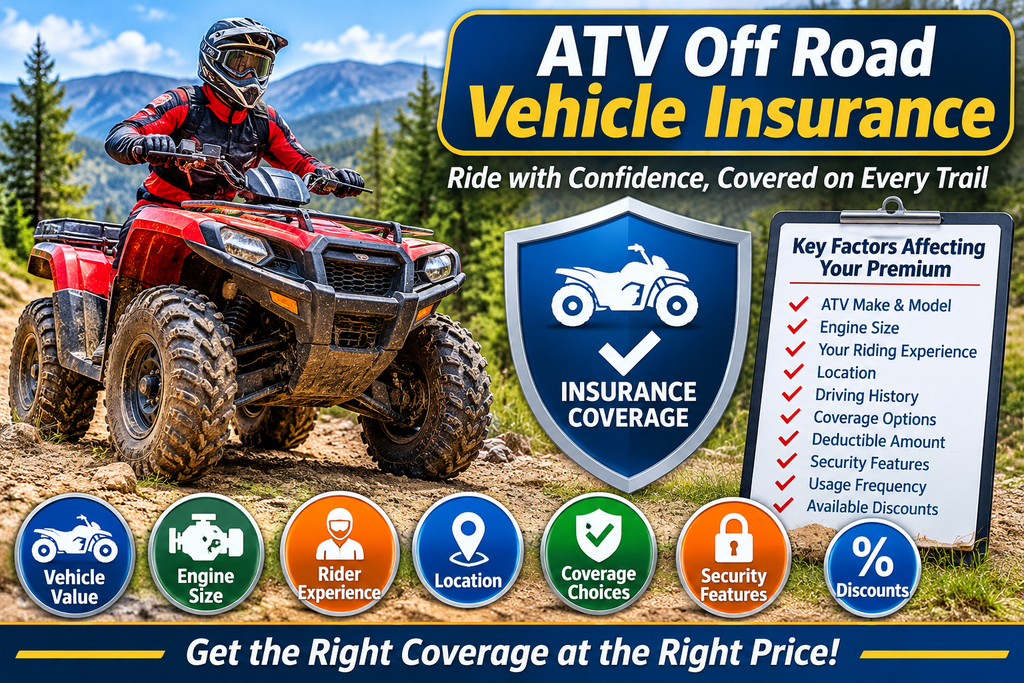
Insurance companies consider factors such as:
- Manufacturer and model.
- Original purchase price.
- Current market value.
- Replacement cost.
- Vehicle age and condition.
- Repair and replacement expenses.
For example, an expensive ATV with advanced technology, specialized components, and costly replacement parts may require a higher comprehensive or collision premium.
How to save: Compare insurance quotes for different coverage options and provide accurate information about your ATV’s value. Avoid paying for coverage that duplicates protection you already have.
2. ATV Engine Size and Performance
Engine size is another important consideration when determining ATV insurance costs.
Generally, larger-engine ATVs can deliver greater power and speed. Depending on the model and intended use, insurers may consider these vehicles to have a higher accident or injury risk.
For example:
- Smaller-engine ATVs are often designed for recreational riding and beginners.
- Mid-size ATVs may be used for general outdoor recreation and utility activities.
- Larger-engine ATVs may offer greater power and performance for experienced riders.
However, engine size alone does not determine your insurance premium. The vehicle’s design, safety features, intended use, and insurer-specific underwriting rules also matter. Best ATV off road vehicle insurance
How to save: Choose an ATV that matches your riding experience and intended activities. Provide accurate engine and performance information when requesting insurance quotes.
3. Your Age and Riding Experience
Your age and experience may influence how an insurance company evaluates your risk as an ATV rider.
Experienced riders may have a more established safety record and greater familiarity with handling different off-road conditions.
New riders may have less experience dealing with:
- Uneven terrain.
- Steep hills.
- Muddy or slippery trails.
- Sudden obstacles.
- High-speed turns.
- Unexpected changes in weather.
Some insurers consider age, riding experience, training, and previous insurance history when calculating premiums.
How to save: Consider completing a recognized ATV safety course. Ask your insurance provider whether it offers discounts for approved rider training or safety certifications.
4. Your Location and Riding Area
Where you live and regularly operate your ATV can have a significant effect on insurance costs.
Insurance companies may consider local accident rates, theft frequency, weather conditions, repair expenses, and other location-related risks.
For example, an ATV owner living in an area with frequent vehicle theft or expensive repair services may face different insurance costs from someone in a lower-risk location.
Your regular riding environment also matters.
Potential riding locations include:
- Public off-road trails.
- Private recreational properties.
- Farms and agricultural land.
- Forest and mountain trails.
- Desert riding areas.
- Designated ATV parks.
Different locations create different risks, and some policies may restrict where the vehicle can be operated.
How to save: Provide accurate information about where you store and ride your ATV. Ask your insurer whether your policy covers public trails, private land, and out-of-state recreational use.
5. Your Driving and Claims History
Your previous insurance and claims history can affect the price of your ATV coverage.
Insurance companies may review available information about previous claims, accidents, and relevant driving or riding violations.
A history of frequent claims may indicate a higher risk to an insurer, potentially resulting in higher premiums.
Factors that may influence your insurance profile include:
- Previous ATV accidents.
- At-fault claims.
- Frequent insurance claims.
- Relevant traffic or riding violations.
- Previous policy cancellations for nonpayment.
- Gaps in insurance coverage.
However, insurers do not all evaluate these factors in the same way.
How to save: Maintain a responsible riding record, follow safety rules, and avoid unnecessary claims when paying for a small repair yourself makes financial sense.
6. How Frequently You Use Your ATV
The number of hours or days you ride your ATV can influence your insurance premium.
Someone who rides occasionally on weekends may have a different risk profile from someone who operates an ATV almost every day.
Insurance companies may consider:
- Estimated annual riding hours.
- Frequency of recreational trips.
- Regular off-road activities.
- Seasonal or year-round usage.
- Commercial or agricultural use.
Frequent riding can increase exposure to accidents, theft, and damage.
For example, an ATV used occasionally for recreational trail riding may have a different premium from one used daily for farm operations.
How to save: Give your insurer an accurate estimate of annual usage. If you only ride seasonally, ask whether a seasonal policy or another flexible coverage option is available.
7. Your Selected Coverage Types and Limits
The amount and type of insurance protection you select directly affect your premium.
A basic liability-only policy will generally cost less than a policy that includes liability, collision, comprehensive, and additional optional protections.
Here is a comparison of common ATV coverage options:
| Coverage type | What it protects |
|---|---|
| Liability | Covered injuries or property damage you cause to others |
| Collision | Covered damage to your ATV following a collision |
| Comprehensive | Covered theft, vandalism, fire, and other non-collision losses |
| Medical payments | Eligible medical expenses after an accident |
| Uninsured motorist | Certain injuries caused by an uninsured or underinsured motorist |
| Accessories coverage | Eligible ATV upgrades and installed equipment |
Choosing higher coverage limits generally increases your premium, but it can also provide stronger financial protection.
How to save: Compare liability-only and broader coverage packages. Select limits that reflect your financial situation, vehicle value, and potential exposure rather than automatically choosing the cheapest option.
8. ATV Storage and Security Features
Where and how you store your ATV can influence your insurance costs, particularly for comprehensive coverage.
ATVs are attractive targets for thieves because they can be transported relatively easily and may have valuable replacement parts.
Insurance companies may consider whether your vehicle is stored:
- Inside a locked garage.
- In a secured storage facility.
- In a fenced private property.
- In an outdoor parking area.
- In an unsecured location.
Security equipment may also help reduce theft risks.
Examples include:
- GPS tracking devices.
- Anti-theft alarms.
- Heavy-duty wheel locks.
- Security chains.
- Immobilizers.
- Locked storage enclosures.
Some insurers offer discounts for qualifying anti-theft equipment.
How to save: Store your ATV in a locked garage whenever possible and ask your insurer which approved security devices qualify for discounts.
9. Your ATV Deductible Amount
Your deductible is the amount you agree to pay out of pocket before your insurance company pays an eligible covered claim.
The deductible you select can affect your monthly or annual premium.
For example, consider the following hypothetical comparison:
| Deductible | Potential premium impact |
|---|---|
| $250 | Generally higher premium |
| $500 | Moderate premium |
| $1,000 | Generally lower premium |
| $1,500 | Potentially lower premium |
These are illustrative deductible options, not actual insurance quotes.
Generally, choosing a higher deductible reduces the insurer’s potential payment for certain claims, which may lower your premium.
However, a higher deductible also means you must pay more when filing a covered claim.
How to save: Choose a deductible you can comfortably afford. Do not increase it simply to reduce your premium if paying that amount after an accident would create financial difficulties.
10. Available Insurance Discounts and Bundling Options
Insurance discounts can help reduce the total cost of ATV coverage.
Many insurance companies offer savings opportunities to eligible ATV owners who meet certain requirements.
Common discount opportunities include:
- Multi-policy discount: Insuring your ATV and another eligible policy with the same company.
- Multi-vehicle discount: Covering multiple ATVs or recreational vehicles.
- Safety course discount: Completing an approved ATV safety training program.
- Experienced rider discount: Qualifying based on riding experience and insurer requirements.
- Anti-theft discount: Installing approved theft-prevention equipment.
- Paid-in-full discount: Paying the annual premium upfront, if available.
- Claims-free discount: Maintaining an eligible history without claims.
Not every insurance provider offers the same discounts, and eligibility requirements vary by state and company.
How to save: Ask your insurance agent to review every available discount before purchasing or renewing your ATV insurance policy.
Additional Tips to Lower Your ATV Off-Road Vehicle Insurance Premium
Understanding the factors that influence premiums is the first step. You can also take practical actions to make ATV insurance more affordable.
Compare Multiple Insurance Quotes
Do not automatically accept the first quote you receive. Different insurance companies may evaluate the same ATV and rider differently.
Compare at least three quotes and review:
- Annual premium.
- Liability limits.
- Collision and comprehensive coverage.
- Deductible amounts.
- Exclusions and restrictions.
- Available discounts.
- Claims service and reputation.
Make sure you compare similar coverage levels rather than choosing a policy based only on its price.
Maintain a Safe Riding Record
Responsible riding habits can help prevent accidents and reduce the likelihood of insurance claims.
Always follow recommended safety practices, avoid reckless driving, and wear appropriate protective equipment.
Review Your Policy Annually
Your ATV insurance needs may change when you purchase a new vehicle, modify your ATV, move to another location, or change your riding habits.
Reviewing your policy annually can help you identify unnecessary coverage costs and potential protection gaps.
Avoid Unnecessary Modifications
Performance upgrades and expensive accessories may increase the value of your ATV or change its risk profile.
Inform your insurer about significant modifications and ask whether they are covered before making changes.
Keep Your ATV Properly Maintained
Regular maintenance can help reduce mechanical problems and improve safe operation.
Although standard ATV insurance generally does not cover routine maintenance or ordinary mechanical breakdowns, maintaining your vehicle can help prevent avoidable accidents.
How Much Does ATV Off-Road Vehicle Insurance Cost?
There is no single price for ATV insurance in the United States. Premiums vary depending on the vehicle, rider profile, location, selected coverage, and insurance company.
For example, an older utility ATV with basic liability protection may cost less to insure than a newer, high-performance ATV with comprehensive and collision coverage.
To understand your potential insurance costs, request personalized quotes from multiple providers.
When comparing prices, consider the total value of the protection rather than focusing exclusively on the lowest premium.
A slightly more expensive policy may offer better coverage limits, more useful benefits, or a lower deductible.
Choosing the Right ATV Insurance Company
Selecting an insurance provider is just as important as choosing the right coverage.
Some well-known U.S. insurance companies offering ATV or off-road vehicle insurance include:
- GEICO.
- Progressive.
- Nationwide.
- Allstate.
- State Farm.
Coverage availability, eligibility, and discounts depend on your location and vehicle.
Before purchasing a policy, check the insurer’s financial strength, customer service, claims process, policy exclusions, and available coverage options.
Frequently Asked Questions About ATV Off-Road Vehicle Insurance
1. What factors affect ATV insurance premiums the most?
The most common factors include ATV make and model, engine size, vehicle value, rider experience, location, claims history, coverage limits, and deductible. Each insurance company may evaluate these factors differently.
2. Is ATV insurance required in the United States?
ATV insurance requirements vary by state and riding location. Some states or public riding areas require liability coverage, while private-property use may have different requirements. Check your state’s laws and local trail regulations before riding.
3. Does a larger ATV engine increase insurance costs?
It can. Larger-engine ATVs may have greater speed and performance capabilities, which some insurers consider when evaluating risk. However, engine size is only one factor in determining premiums.
4. Can I get cheap ATV insurance with full coverage?
Yes. Comparing multiple providers, maintaining a clean claims history, completing safety training, and qualifying for discounts may help you find affordable full coverage.
5. Does ATV insurance cover theft?
Comprehensive coverage generally protects against covered ATV theft, subject to policy terms, limits, and deductibles. Basic liability coverage does not normally cover theft of your own vehicle.
6. Does ATV insurance cover accidents on off-road trails?
Many ATV policies provide coverage for eligible off-road accidents. However, coverage depends on the policy’s terms, permitted riding locations, exclusions, and circumstances of the accident.
7. Can I lower my ATV insurance premium by increasing my deductible?
Yes. Selecting a higher deductible may reduce your premium. However, you will need to pay more out of pocket when filing an eligible claim.
8. Are ATV safety courses eligible for insurance discounts?
Some insurance companies offer discounts to riders who complete approved ATV safety courses. Contact your provider to confirm the course requirements and available savings.
9. Does homeowners insurance cover my ATV?
Some homeowners policies may provide limited coverage for certain ATV-related losses, but exclusions and restrictions often apply. Separate ATV insurance may provide more appropriate protection for vehicle damage and liability.
10. How often should I compare ATV insurance quotes?
It is a good idea to compare quotes at least once a year or whenever your vehicle, location, riding habits, or coverage requirements change.
Conclusion
Your ATV off-road vehicle insurance premium depends on several factors, including your vehicle’s value, engine size, riding experience, location, claims history, usage, and selected coverage options.
Understanding these 10 factors can help you make smarter insurance decisions and avoid paying more than necessary.
The best way to find affordable ATV insurance is to compare multiple providers, maintain safe riding habits, explore available discounts, and choose coverage that matches your financial needs.
Remember, the cheapest policy is not always the best option. Prioritize reliable protection against accidents, theft, and liability claims so you can enjoy your off-road adventures with greater confidence.