
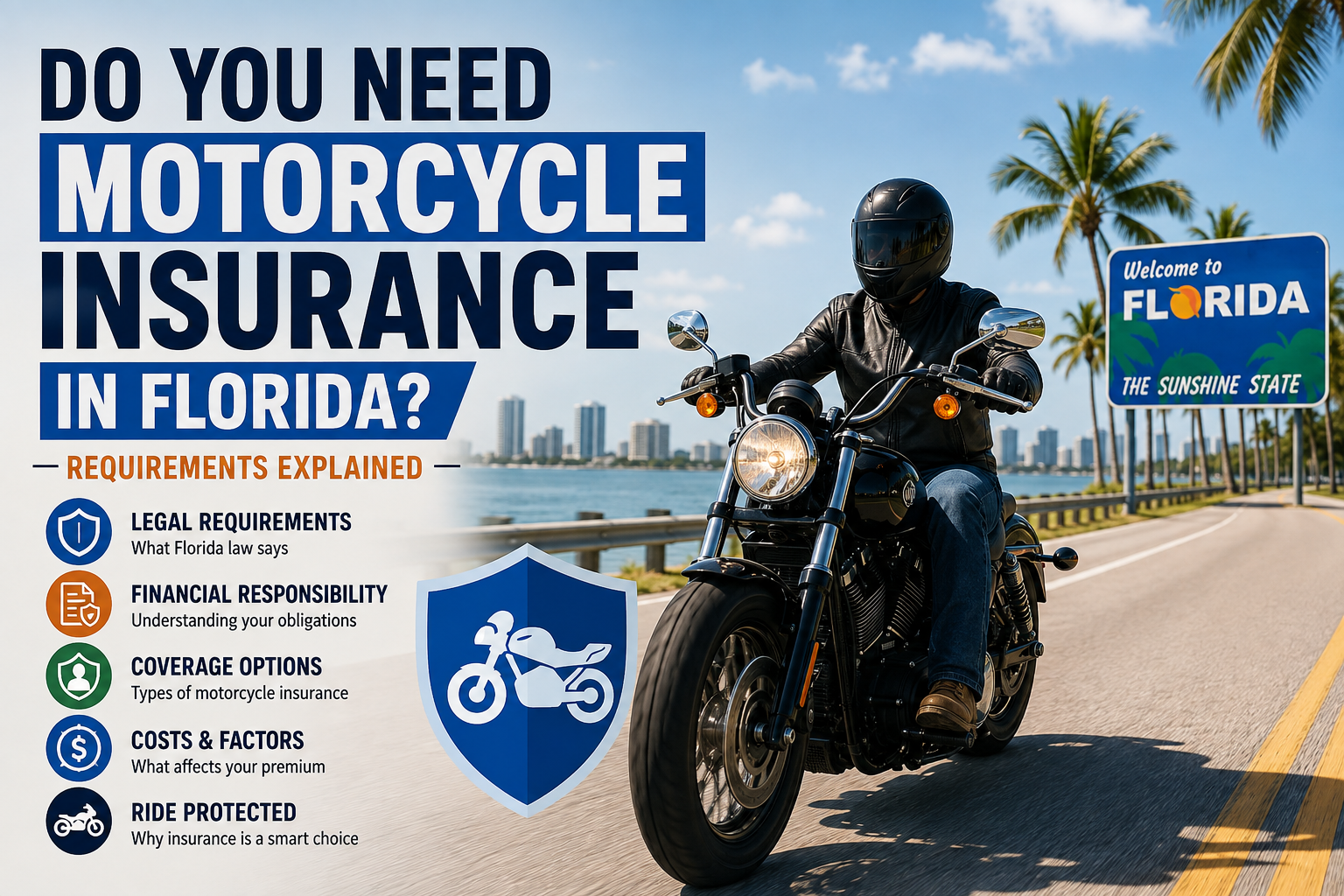
Riding a motorcycle in Florida can be an exciting way to travel, enjoy the warm weather, and explore the state’s highways and scenic roads. However, before getting on the road, every rider should understand the rules surrounding motorcycle insurance in Florida.
One of the most common questions asked by riders is: Do you need motorcycle insurance in Florida? The answer is more complicated than a simple yes or no. Florida has different insurance rules for motorcycles than for standard passenger vehicles. A rider may not be required to carry a traditional motorcycle insurance policy before registering and riding in every situation, but Florida’s financial responsibility laws can create important insurance obligations, particularly after certain crashes or incidents.
In addition, insurance may be necessary for practical reasons even when a policy is not required simply to ride. A serious motorcycle accident can result in expensive medical bills, property damage, lawsuits, and other financial losses. Understanding the law and choosing appropriate coverage can therefore be essential for protecting both yourself and your finances.
This guide explains Florida motorcycle insurance requirements, financial responsibility rules, helmet-related insurance requirements, common types of motorcycle coverage, and why purchasing insurance may still be a smart decision.
Is Motorcycle Insurance Required in Florida?
Florida is unusual because motorcycle insurance is not handled exactly like ordinary automobile insurance. In general, Florida does not impose the same no-fault insurance requirements on motorcycles that apply to many passenger cars.
However, this does not mean that Florida motorcycle riders have no financial responsibilities after an accident.
Florida’s financial responsibility laws are designed to ensure that people who cause certain crashes can demonstrate an ability to pay for damages. Under Florida law, proof of financial responsibility generally involves the ability to respond to damages at specified minimum levels, including $10,000 for bodily injury or death of one person, $20,000 for bodily injury or death of two or more people, and $10,000 for property damage in applicable situations. The state’s financial responsibility statutes also establish rules for how this responsibility can be demonstrated.
Therefore, riders should not interpret the absence of a blanket requirement to purchase a conventional policy before every ride as meaning they are automatically protected from financial consequences.
If you cause an accident and do not have adequate insurance or another acceptable method of meeting financial responsibility requirements, you could face significant personal financial exposure. Depending on the circumstances, additional consequences may also affect your ability to maintain driving privileges or vehicle registration.
Why Florida’s Motorcycle Rules Are Different
Florida’s insurance system can be confusing because the state is widely associated with no-fault automobile insurance. For many four-wheeled vehicles, owners generally encounter requirements involving Personal Injury Protection, commonly called PIP, and property damage liability coverage.
Motorcycles are treated differently.
As a result, motorcycle riders should avoid assuming that their car insurance automatically provides the same protection when they ride a motorcycle. A standard auto policy may have separate terms, exclusions, or requirements relating to motorcycles.
Motorcycle insurance is usually purchased through a separate motorcycle policy or through coverage specifically designed to include the motorcycle. The available protection may include liability coverage, collision coverage, comprehensive coverage, uninsured or underinsured motorist protection, and medical-related coverage.
Because the rules differ from standard automobile insurance, it is important to read your policy carefully and verify exactly what is covered.
Understanding Florida Financial Responsibility
The most important concept for Florida motorcycle riders is financial responsibility.
Financial responsibility essentially means having the ability to pay damages when you are legally responsible for injuries or property damage arising from a motor vehicle accident.
Florida’s statutes describe minimum financial responsibility amounts that include:
- $10,000 for bodily injury or death of one person
- $20,000 for bodily injury or death of two or more people in one crash
- $10,000 for property damage in one crash
Florida law also provides methods for proving financial responsibility and specifies requirements applicable to motor vehicle liability policies used as proof.
These figures should not automatically be viewed as a recommendation for how much insurance a rider should purchase. They represent statutory financial responsibility amounts in applicable circumstances, while the actual cost of a serious accident can be substantially higher.
For example, imagine a motorcycle rider causes a crash involving several vehicles. The damage could include expensive vehicle repairs, emergency medical treatment, hospitalization, lost income, rehabilitation, and legal claims. A minimum level of financial protection may not be enough to cover all of those losses.
Any amount that is not covered by applicable insurance could potentially become the responsibility of the person legally liable for the accident.
What Happens if You Cause a Motorcycle Accident Without Insurance?
Riding without a motorcycle insurance policy may initially appear to save money. However, the financial consequences of an accident can be much greater than the cost of maintaining coverage.
If you are found legally responsible for a crash, the injured person or property owner may seek compensation for covered losses. Depending on the facts of the case, these losses could include:
- Medical expenses
- Property damage
- Lost income
- Pain and suffering where legally recoverable
- Rehabilitation costs
- Future medical expenses
- Other damages recognized under applicable law
Without adequate liability coverage, you may have to pay some of these expenses from your personal assets.
Florida’s financial responsibility laws are also intended to ensure that qualifying drivers and vehicle owners can respond financially to damages. The law provides for consequences involving licenses and registrations in circumstances covered by the statutes, including situations involving failure to satisfy applicable financial responsibility requirements.
The exact consequences depend on the facts of the crash and the applicable legal provisions. For this reason, riders should not rely on a general statement that insurance is “not required” without understanding the larger financial responsibility system.
Do You Need Insurance to Register a Motorcycle in Florida?
Florida’s motorcycle registration rules differ from the insurance requirements commonly associated with standard passenger automobiles.
A rider should verify current requirements with the appropriate Florida agencies when registering a motorcycle because registration rules and documentation requirements can change. It is also important to distinguish between:
- What is required to register or operate the motorcycle
- What financial responsibility may be required after a qualifying event
- What a lender requires if the motorcycle is financed
- What insurance may be needed for practical financial protection
These are separate questions.
For example, a lender financing your motorcycle may require you to maintain certain insurance coverages even if Florida law does not require the same policy simply as a condition of ordinary motorcycle operation.
Similarly, a motorcycle lease agreement may contain insurance requirements established by the leasing company.
Always review your financing or leasing contract before deciding to reduce or cancel coverage.
Is Liability Insurance a Good Idea for Florida Motorcycle Riders?
Yes. For most riders, liability insurance is one of the most important types of motorcycle coverage.
Liability insurance is designed to provide protection when you are legally responsible for causing bodily injury or property damage to another person.
Bodily Injury Liability
Bodily injury liability coverage may help pay damages associated with injuries suffered by another person when you are legally responsible for an accident, subject to the policy’s terms and limits.
A serious motorcycle crash can cause severe injuries. Emergency transportation, hospital treatment, surgery, rehabilitation, and lost wages can quickly create substantial claims.
For this reason, riders should carefully consider whether a low liability limit would provide enough protection for their financial situation.
Property Damage Liability
Property damage liability may help pay for damage you cause to another person’s vehicle or other property, subject to policy terms and limits.
Modern vehicles can be expensive to repair. A crash involving a luxury vehicle, commercial vehicle, multiple cars, or valuable property could create losses far exceeding a basic amount of coverage.
Choosing appropriate liability limits is therefore an important part of buying motorcycle insurance.
Do You Need Medical Coverage to Ride Without a Helmet?
Florida has a particularly important insurance-related rule involving helmets.
Florida law generally requires motorcycle riders to wear qualifying protective headgear. However, the law provides an exception for a person over 21 years old who is covered by an insurance policy providing at least $10,000 in medical benefits for injuries resulting from a motorcycle crash. Eye protection is also required under the applicable statute.
This means insurance can become directly relevant to a rider’s decision to legally ride without a helmet under Florida’s helmet exception.
A rider under the age threshold should not assume that the same exception applies.
The law also contains additional provisions for certain low-powered motorcycles and mopeds. Riders should review the specific rules that apply to their vehicle rather than assuming every two-wheeled vehicle is treated identically.
Because helmet and insurance requirements can involve specific statutory conditions, riders should confirm that their policy actually provides the required medical benefits before relying on the exception.
What Types of Motorcycle Insurance Should You Consider?
Even if you are not purchasing coverage solely because of a registration requirement, a motorcycle insurance policy can provide valuable protection.
Here are some of the most common types of coverage.
1. Liability Coverage
Liability coverage is generally the starting point for financial protection.
It may include coverage for:
- Bodily injury to others
- Property damage caused to others
Policy limits are extremely important. A policy only provides protection up to its applicable limits, subject to its terms and exclusions.
2. Collision Coverage
Collision coverage may help pay to repair or replace your motorcycle after damage caused by a collision with another vehicle or object, subject to the policy terms and deductible.
This can be particularly valuable if your motorcycle is expensive.
If you financed your motorcycle, collision coverage may also be required by the lender.
3. Comprehensive Coverage
Comprehensive coverage may protect against certain losses not caused by a collision, depending on the policy.
Examples can include covered losses resulting from:
- Theft
- Fire
- Vandalism
- Certain weather events
- Falling objects
Florida’s weather conditions can be an important consideration. Riders may want to evaluate potential exposure to storms and other covered risks when deciding whether comprehensive coverage is worthwhile.
4. Uninsured and Underinsured Motorist Coverage
Not every driver on the road has adequate insurance.
Uninsured motorist coverage may help in certain situations when you are injured by a driver who has no applicable insurance. Underinsured motorist coverage may help when the responsible driver’s available coverage is insufficient for covered losses.
The precise protection depends on the policy and applicable law.
For motorcycle riders, this coverage can be especially important because riders have less physical protection than occupants of enclosed vehicles.
5. Medical Payments or Other Medical Benefits
Medical-related motorcycle coverage may help with qualifying medical expenses depending on the policy.
This type of protection deserves special attention in Florida because, as discussed earlier, a rider over 21 who wants to use Florida’s helmet exception must be covered by a policy providing at least $10,000 in medical benefits for motorcycle crash injuries.
Do not assume that every insurance policy automatically provides the medical benefits needed for the helmet exception. Review the policy language and ask the insurer or a licensed insurance professional if you need clarification.
How Much Motorcycle Insurance Should You Buy?
There is no single amount that is perfect for every Florida rider.
The right coverage depends on several factors, including:
- Your income and assets
- The value of your motorcycle
- Whether the motorcycle is financed
- How often you ride
- Where you ride
- Whether you carry passengers
- Your tolerance for financial risk
- Your existing health insurance
- The liability limits available under your policy
A rider with significant savings, property, or other assets may want higher liability limits because a major lawsuit could place those assets at risk.
A rider with an expensive motorcycle may also want collision and comprehensive protection.
On the other hand, a rider with an older motorcycle of relatively low value may decide that the cost of physical damage coverage is not worthwhile compared with the potential payout after a deductible.
The best approach is to compare the annual or monthly premium with the financial risk you would assume by remaining uninsured or underinsured.
Factors That Affect the Cost of Motorcycle Insurance in Florida
Motorcycle insurance prices can vary considerably.
Insurance companies may consider factors such as:
Rider Age and Experience
Experienced riders may be viewed differently from inexperienced riders. A new rider may face different pricing based on the insurer’s underwriting standards.
Driving and Claims History
Traffic violations, accidents, and previous claims can affect the cost of insurance.
Type of Motorcycle
A high-performance motorcycle may cost more to insure than a smaller or less powerful motorcycle.
The value of the motorcycle and the expected cost of repairs can also influence premiums.
Location
Where you live and store your motorcycle can affect insurance pricing. Insurers may consider factors related to traffic, theft risk, weather exposure, claims history, and population density.
Coverage Limits
Higher liability limits generally provide greater financial protection, although they may also increase premiums.
Deductible
A higher deductible may reduce the premium for certain physical damage coverages, but it means you could pay more out of pocket before coverage applies.
Can Your Car Insurance Cover Your Motorcycle?
You should never assume that your standard automobile insurance policy automatically covers your motorcycle.
Motorcycles are often insured separately because they involve different risks and may be specifically excluded from an auto policy.
Before riding, check:
- Whether your motorcycle is listed on a policy
- Which riders are covered
- Your liability limits
- Whether collision and comprehensive coverage apply
- Whether medical benefits are included
- Whether uninsured or underinsured motorist protection applies
- The policy exclusions and deductibles
If the policy documents are unclear, contact the insurance company or a licensed insurance agent for an explanation.
What if You Finance Your Motorcycle?
A lender can have insurance requirements separate from Florida’s basic legal requirements.
When you borrow money to purchase a motorcycle, the lender has a financial interest in the vehicle until the loan is paid off. Because of this, the loan agreement may require you to maintain physical damage coverage.
Common lender requirements may include:
- Collision coverage
- Comprehensive coverage
- Specific deductible limits
- Listing the lender as a loss payee or lienholder
If you cancel required insurance, the lender may take action permitted by the loan agreement.
Therefore, always read your financing contract carefully.
How to Choose the Right Florida Motorcycle Insurance Policy
Choosing insurance should involve more than selecting the cheapest premium.
Follow these steps:
Step 1: Determine Your Legal and Contractual Requirements
Find out whether you have any requirements arising from Florida law, your financing agreement, a lease, or another contract.
Step 2: Consider Your Financial Risk
Think about what could happen if you caused a serious crash and faced a large liability claim.
Step 3: Evaluate Your Motorcycle’s Value
Consider whether you could afford to repair or replace the motorcycle yourself.
Step 4: Compare Coverage, Not Just Prices
A cheap policy with very low limits or major exclusions may provide less protection than you expect.
Compare:
- Liability limits
- Medical-related benefits
- Deductibles
- Collision protection
- Comprehensive protection
- Uninsured and underinsured motorist coverage
- Policy exclusions
Step 5: Review the Policy Before Buying
Read the declarations page and policy documents.
Pay close attention to:
- Who is insured
- What motorcycle is covered
- When coverage applies
- Policy limits
- Deductibles
- Exclusions
- Cancellation provisions
Final Thoughts
So, do you need motorcycle insurance in Florida?
Florida does not treat motorcycles exactly the same way it treats ordinary passenger vehicles for insurance purposes, and riders should understand that the absence of a simple blanket insurance requirement does not eliminate the risk of financial responsibility after an accident. Florida’s financial responsibility laws establish requirements concerning the ability to respond to damages, including statutory amounts of $10,000 for one person’s bodily injury or death, $20,000 for two or more people, and $10,000 for property damage in applicable circumstances.
Insurance also plays a direct role in Florida’s helmet rules. Riders over 21 may qualify to ride without protective headgear only if they meet the statutory exception, including coverage providing at least $10,000 in medical benefits for injuries from a motorcycle crash.
For most motorcycle owners, purchasing insurance is a practical decision even when a policy is not required simply for every stage of registration or operation. Liability claims, medical expenses, motorcycle repairs, theft, and uninsured drivers can create financial risks that may be difficult to manage without appropriate coverage.
Before choosing a policy, compare your options carefully, review current Florida laws, consider your personal financial situation, and understand exactly what your insurance covers. A well-chosen motorcycle insurance policy can provide valuable financial protection and greater peace of mind every time you get on the road.
Disclaimer: This article is for general informational purposes only and is not legal or insurance advice. Florida laws and insurance requirements can change, and individual circumstances may differ. Check current official Florida requirements and consult a qualified professional for advice about your specific situation.
Frequently Asked Questions (FAQs)
1. Is motorcycle insurance required in Florida?
Florida generally does not require motorcycle riders to carry the same PIP and property-damage insurance required for many passenger vehicles. However, riders can still have financial responsibility after an accident, and insurance may be required by a lender or needed to qualify for the helmet exception.
2. Do you need insurance to ride a motorcycle without a helmet in Florida?
If you are over 21, Florida law allows you to ride without a helmet only if you have an insurance policy providing at least $10,000 in medical benefits for motorcycle-crash injuries.
3. Do motorcycle riders under 21 have to wear a helmet in Florida?
Yes. Florida’s helmet exception applies to riders over 21 who meet the insurance requirement. Riders under 21 must wear qualifying protective headgear when operating or riding on a motorcycle.
4. Is eye protection required when riding a motorcycle in Florida?
Yes. Florida law generally requires motorcycle operators to wear an approved eye-protective device.
5. Does my car insurance automatically cover my motorcycle?
Usually, you should not assume so. Motorcycle coverage is commonly handled under a separate policy or specifically included coverage. Check your policy documents or ask your insurer whether your motorcycle is covered.
6. What happens if I cause a motorcycle accident without insurance?
You may be personally responsible for damages if you are legally liable for injuries or property damage. Depending on the circumstances, Florida’s financial responsibility laws can also create additional consequences.
7. What types of motorcycle insurance should I consider in Florida?
Common options include liability coverage, collision coverage, comprehensive coverage, uninsured/underinsured motorist coverage, and medical-related coverage. The right combination depends on your motorcycle’s value, finances, riding habits, and personal risk level.
8. Is liability insurance a good idea for Florida motorcycle riders?
Yes. Even when coverage is not required in the same way as standard automobile insurance, liability coverage can help protect you financially if you are legally responsible for injuring someone or damaging their property.
9. Do I need collision and comprehensive coverage?
These coverages may be worth considering if your motorcycle is valuable or difficult to replace. Collision generally addresses covered crash damage, while comprehensive may cover qualifying non-collision losses such as theft, fire, vandalism, or certain weather-related damage.
10. Does a financed motorcycle need insurance?
Often, yes. Your lender may require collision and comprehensive coverage until the loan is paid off. Always check the terms of your loan agreement.
11. How much medical insurance do I need to ride without a helmet in Florida?
Florida’s helmet exception requires a rider over 21 to be covered by an insurance policy providing at least $10,000 in medical benefits for injuries resulting from a motorcycle crash.
12. What factors affect motorcycle insurance costs in Florida?
Rates may depend on factors such as your age and riding experience, driving history, motorcycle type and value, location, coverage limits, deductible, and claims history.
13. Is uninsured motorist coverage important for motorcycle riders?
It can be valuable because it may provide protection in covered situations involving a driver who has no insurance or insufficient insurance. Review the policy’s specific terms, limits, and exclusions before purchasing coverage.
14. Should I buy motorcycle insurance even if it is not required?
For many riders, yes. Insurance can help reduce the financial impact of liability claims, accident-related losses, theft, damage, and other covered risks. The best coverage depends on your individual circumstances.
15. What should I check before buying motorcycle insurance in Florida?
Compare coverage limits, deductibles, exclusions, medical benefits, liability protection, physical-damage coverage, and uninsured/underinsured motorist options. Also verify whether your policy meets any lender requirements or the $10,000 medical-benefit requirement if you intend to rely on Florida’s helmet exception.
Read More:


One thought on “Do You Need Motorcycle Insurance in Florida? Requirements Explained”