
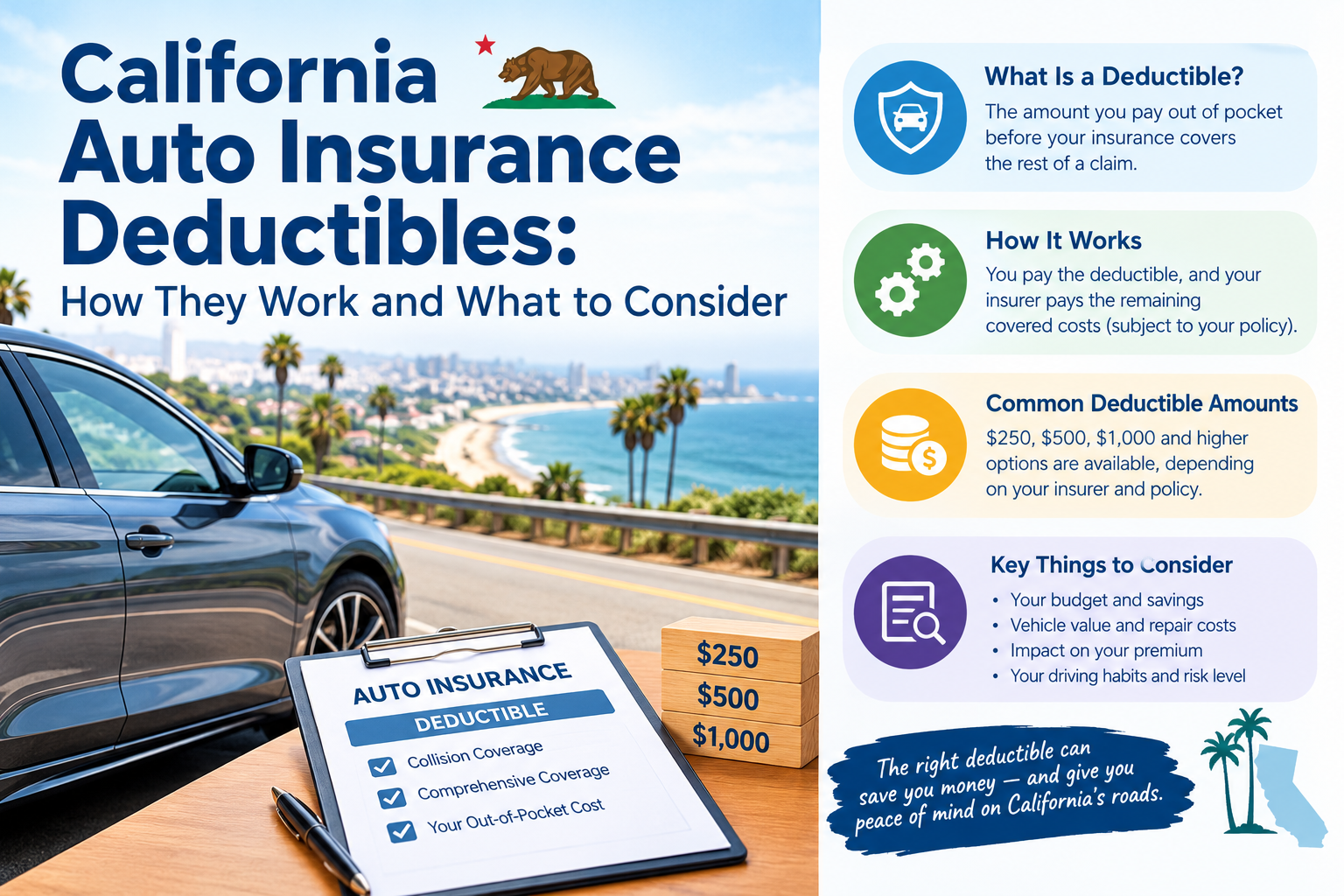
In car insurance, a deductible is the amount a policyholder generally pays out of pocket toward a covered claim before the insurer pays its share. Put simply, asking “what is a deductible in car insurance in California” means asking how much you may need to contribute when certain damage is repaired under your policy. The deductible applies only when the claim falls under coverage that carries one, and the policy’s terms determine how it is calculated and paid.
For example, suppose a covered repair costs $3,000 and the applicable deductible is $500. You would generally be responsible for the first $500, and the insurer may pay the remaining $2,500. That example assumes the repair is approved and the loss is covered; actual payment can depend on the insurer’s claim decision, policy limits, exclusions, and other terms. If the covered cost is lower than the deductible, you may need to pay the full repair amount yourself.
A deductible is different from a premium, which is the price you pay to keep insurance in force. It is also separate from a coverage limit, the maximum amount an insurer may pay for a covered loss. The deductible is your share of an eligible claim, while the premium is paid for the policy and the limit sets an upper boundary on the insurer’s payment. These amounts serve different purposes and should not be confused when comparing policies.
Deductibles do not apply to every type of auto insurance coverage. Collision and comprehensive coverage commonly have deductibles, while liability coverage generally does not have one for damage or injuries you cause to others. If another driver is responsible, their liability coverage may be relevant to your claim; that is distinct from the deductible on your own policy, though fault and claim handling can affect the process. Check your declarations page and policy wording to see which coverages have deductibles and the amount that applies.
When considering what is a deductible in car insurance in california, it helps to look at each coverage separately. A deductible is generally the amount a policyholder pays toward a covered loss before the insurer pays the remaining eligible amount, subject to the policy’s limits, exclusions, and other conditions. It does not necessarily apply to every part of an auto policy.
Collision coverage commonly includes a deductible. It may apply when your vehicle is damaged in a collision with another vehicle or object, or in a rollover. If the insurer approves the claim, you typically pay the selected deductible toward repairs or the vehicle’s covered value, and the insurer pays the covered balance. The amount and claim outcome depend on the contract and circumstances. A deductible may also apply to comprehensive coverage, which generally addresses certain non-collision losses, such as theft, vandalism, falling objects, or some weather-related damage.
Liability coverage works differently. It is intended to address covered injuries or property damage for which you are legally responsible. When your insurer handles a covered claim made against you, liability coverage generally does not require you to pay a policyholder deductible. However, liability coverage does not usually pay to repair damage to your own vehicle; collision or another applicable coverage may be needed for that purpose.
Other coverages can have distinct rules. Medical payments coverage may pay eligible medical expenses without a deductible, but its terms and limits vary. Uninsured or underinsured motorist property damage coverage may have a deductible, or may be subject to specific conditions about whether it applies. Do not assume these coverages follow the same rules as collision or comprehensive protection.
Check your declarations page for listed coverages, limits, and deductible amounts, then review the policy wording for how each deductible is applied. If a claim involves more than one coverage, the contract may determine whether one or multiple deductibles apply. Ask your insurer or agent to explain any unclear terms before choosing coverage or filing a claim.
Collision coverage may help pay to repair or replace your insured vehicle when it is damaged in a collision with another vehicle or an object, such as a fence, pole, or guardrail. It may also apply to certain single-car accidents, including a vehicle overturning or striking a stationary object. This coverage is generally relevant when damage results from impact, regardless of whether another vehicle was involved. If you are asking what is a deductible in car insurance in california, the collision deductible is the amount you may need to pay toward an eligible collision claim before your insurer contributes, subject to your policy terms and limits.
Comprehensive coverage generally applies to covered losses that do not involve a collision with another vehicle or object. Examples may include theft, vandalism, fire, falling objects, and some weather-related damage, such as hail. It may be the relevant coverage if a car is stolen or damaged by a fallen tree, while collision may be more likely to apply if the driver hits a tree. These are general distinctions, not guarantees: policy definitions, exclusions, deductibles, and the circumstances of the loss determine whether a claim qualifies. Review your policy or ask your insurer about a specific incident.
Collision and comprehensive coverage can each have a separate deductible, and the amount selected for one does not necessarily match the other. For example, damage from a covered parking-lot impact may involve the collision deductible, while covered vandalism may involve the comprehensive deductible. A cracked windshield or water-related damage can depend on the policy and the precise cause, so avoid assuming which coverage applies. When comparing what is a deductible in car insurance in california, consider both the likely claim type and the out-of-pocket amount you could manage. A lower deductible may mean a higher premium, while a higher deductible can reduce the premium but increase your cost after a covered loss. Confirm the applicable coverage and deductible with your insurer before making a claim decision.
To understand what is a deductible in car insurance in california, consider how the amount affects the payment on an approved covered claim. In many cases, the insurer subtracts the applicable deductible from the covered loss, and you are responsible for that portion. The deductible does not necessarily reduce every type of claim; it generally applies to the coverage involved, such as collision or comprehensive, according to the policy.
For example, suppose collision coverage applies to a covered repair bill of $4,000 and the policy has a $1,000 deductible. If the insurer approves the full $4,000 loss, it would typically pay $3,000, while you pay the $1,000 deductible. If the deductible were $500 instead, the insurer’s payment would generally be $3,500, assuming the same approved repair amount and no other policy restrictions. These figures illustrate the basic calculation, not a guaranteed settlement.
Now consider damage estimated at $700 with a $1,000 deductible. Because the covered loss is less than the deductible, you would ordinarily pay the repair cost yourself, and the insurer may make no payment. Filing a claim in this situation may not provide a financial benefit, although you should check your policy and consider whether the damage could be more extensive than initially apparent.
The final payment can differ from a simple subtraction. An insurer may determine its own repair estimate, and its approved amount may not match a shop’s initial quote. Depreciation or other valuation rules may also affect payment where applicable, particularly for certain property or total-loss settlements. Payment arrangements can vary: the insurer may pay a repair facility directly or reimburse you, subject to the policy and claim process. Policy limits can cap what is payable, even when the covered damage is greater.
If a vehicle is declared a total loss, the insurer typically uses a valuation method to determine its actual cash value, then applies any relevant deductible and policy terms. Review the settlement calculation, ask how the estimate was reached, and confirm the deductible and limits that apply before deciding how to proceed.
When deciding what is a deductible in car insurance in California for your circumstances, weigh the amount you would pay after a covered loss against the premium you pay to maintain coverage. A lower deductible generally reduces your out-of-pocket share when you make a covered claim, but insurers may charge a higher premium for that policy. A higher deductible can lower the premium, while leaving you responsible for more of the repair cost before coverage applies. The right balance depends on your finances and the protection you want, rather than a single amount that suits every driver.
Start by considering how much savings you could access quickly if your car were damaged. Choose an amount you could realistically pay without relying on high-interest borrowing or disrupting essential expenses. Also consider your vehicle’s value and likely repair costs: paying for a higher deductible may make less sense if a modest loss would place a strain on your budget. Coverage terms matter, too. A deductible generally applies to the particular coverage involved in a claim, so review your policy or ask your insurer how deductibles work for collision and comprehensive coverage.
Your driving and parking circumstances can help inform the decision. Frequent driving, regular use in congested areas, or parking where damage or theft is more likely may make the cost of a claim worth considering, although no circumstance guarantees a loss. Think about budget stability as well: drivers with limited emergency savings may prefer a lower deductible even if the premium is higher, while those with accessible savings may be comfortable accepting more risk to reduce ongoing costs. Finally, request quotes using several deductible options and compare the premium difference over a year. Calculate whether the potential savings justify the additional amount you would have to pay after a claim. Review the figures alongside your policy limits and exclusions, and revisit your choice when your vehicle, savings, or household budget changes. This approach can help you select coverage that fits your needs without assuming that the lowest premium or deductible is automatically best.
California’s financial-responsibility rules require drivers to show they can cover certain costs if they cause a crash. Most drivers meet this obligation by carrying auto liability insurance at or above the state’s required limits. Liability coverage can help pay for other people’s injuries or property damage when the insured driver is legally responsible, subject to the policy’s terms and limits. It generally does not pay to repair the policyholder’s own vehicle after a collision.
Meeting the state minimum does not mean a driver has comprehensive or collision coverage. These are typically optional coverages, although a lender or leasing company may require them for a financed or leased vehicle. Collision coverage can help pay for damage to the insured car from a crash, while comprehensive coverage can apply to specified non-collision losses, such as theft, vandalism, or certain weather damage. A deductible commonly applies to claims under either coverage. This is the amount the policyholder pays toward a covered loss before the insurer pays the remaining eligible amount, up to applicable limits.
That distinction helps explain what is a deductible in car insurance in California: it is not an amount that automatically applies to every accident or every claim. Liability claims made against a driver’s policy usually do not involve the driver paying a collision-style deductible for damage to someone else’s vehicle. By contrast, a driver who makes a covered claim for damage to their own car may have to pay the deductible selected for that coverage.
Before choosing limits or deductibles, consider the vehicle’s value, available savings, and ability to pay out of pocket after a loss. A higher deductible may reduce the premium, but it also increases the amount owed for a covered claim. California requirements and insurance products can change, so check current state guidance and confirm your policy’s declarations, exclusions, limits, and deductible amounts with your insurer or agent. Do not assume that a minimum-liability policy protects your own vehicle.
When another driver appears to have caused a crash, you generally have two possible routes for handling damage to your vehicle. You can file a claim with that driver’s insurer, or, if you carry collision coverage, you can file with your own insurer. The second option may help move repairs forward while the insurers investigate, but you will usually need to pay your collision deductible first. Understanding what is a deductible in car insurance in California can help you anticipate this out-of-pocket cost.
If you use your own collision coverage, your insurer may seek reimbursement from the at-fault driver or that driver’s insurer through a process called subrogation. Your insurer presents evidence and pursues recovery of the amount it paid, and may also seek to recover your deductible. If it successfully collects funds, you may receive some or all of the deductible back, depending on the recovery and how responsibility is assigned. Reimbursement is not guaranteed, and the process can take time.
Alternatively, if the other driver’s insurer accepts liability and handles your vehicle-damage claim, you may not need to pay your own collision deductible. That insurer may arrange payment directly for covered repairs or reimburse eligible expenses, subject to its investigation and the applicable policy limits. However, an insurer’s acceptance of a claim is not immediate or automatic. It may need to review statements, photographs, repair estimates, a police report, and other evidence before deciding whether its policyholder was responsible.
Disputes about fault can affect both the timing and amount of payment. California uses comparative fault principles, so responsibility may be divided between drivers; an insurer’s determination may therefore differ from your initial understanding of the accident. Coverage limits, exclusions, documentation, and the insurers’ claim decisions also matter. If the other insurer delays or disputes liability, using your own collision coverage may be a practical option if available, though your deductible applies initially. Ask your insurer how it handles subrogation and deductible recovery, keep relevant records, and avoid assuming that a payment or reimbursement is certain until the claim is resolved.
The deductible shown on an auto insurance declarations page may not be the only amount that applies to every loss. Some policies offer a separate deductible for glass damage, while others apply the comprehensive deductible or provide optional glass coverage with different terms. A deductible waiver may also apply in a specific situation, such as a qualifying collision involving an uninsured driver, but eligibility depends on the policy and the facts of the accident. These features are not universal, so check the contract rather than assuming a particular repair will be deductible-free.
Some insurers offer a disappearing-deductible benefit that reduces a collision deductible over time when a driver meets specified requirements. The benefit may have enrollment rules, limits, or other conditions, and it may not apply to every kind of claim. Deductibles can also differ by vehicle on a multi-car policy, or vary according to the coverage involved. To understand what is a deductible in car insurance in California, review the declarations page alongside the policy wording: the listed amount may be specific to one vehicle and one type of coverage, not a single universal figure.
A deductible generally applies to each covered claim or occurrence as defined by the policy, rather than automatically being charged only once per policy year. However, how an insurer groups related damage can depend on the circumstances and contract. If one incident damages several parts of your vehicle, another insured item, or property in a related sequence of events, ask whether the insurer treats the losses as one occurrence or multiple claims. For a total loss, the applicable deductible is generally subtracted from the covered settlement, subject to policy terms and valuation. Before choosing coverage or filing a claim, ask your insurer how the deductible applies to multiple damaged items, related losses, glass repairs, and total-loss payments. Requesting a written explanation can help clarify your potential out-of-pocket cost.
To determine what is a deductible in car insurance in California for your policy, begin with the declarations page. This summary typically lists each insured vehicle, the coverage types, limits, and any deductibles. Check the collision and comprehensive entries separately; they may have different amounts, and a deductible may apply to one type of loss but not another. If you insure multiple vehicles, verify the information for the specific car involved rather than assuming the same terms apply across the policy.
Next, read the policy definitions and the sections describing how claims are handled. Endorsements can change the standard terms, add a special condition, or provide a different deductible for a particular event. Pay particular attention to glass coverage: some policies include a separate glass provision or a deductible waiver, while others treat glass damage under comprehensive coverage and apply its deductible. Do not rely on a general description of coverage when the written contract may contain additional conditions.
If the documents leave room for interpretation, contact your insurer or agent and describe a specific scenario. For example, ask what deductible would apply if a rock cracked your windshield, if your vehicle were stolen, or if you were involved in a collision. Request confirmation in writing when possible. Also ask whether the deductible applies once per claim or separately to different losses, whether any waiver is available, and what documents, photographs, estimates, or receipts the insurer will require.
Before filing, ask how a claim could affect your premiums or other policy terms. The answer can depend on the circumstances, your coverage, and the insurer’s rating rules, so avoid assuming that a claim will or will not change your cost. Compare the expected repair expense with the deductible and consider any relevant claim consequences. Ultimately, the policy contract and the insurer’s determination during the claim process control how the deductible applies. Choose an amount you could realistically pay out of pocket without financial strain, and review it whenever your vehicle, budget, or coverage needs change.
FAQs: California Auto Insurance Deductibles — How They Work and What to Consider
1. What is a deductible in California auto insurance?
A deductible is the amount you pay out of pocket toward a covered vehicle damage claim before your insurance pays the remaining covered amount. In California, deductibles commonly apply to collision and comprehensive coverage.
2. How does a car insurance deductible work in California?
If your car sustains $2,000 in covered damage and your deductible is $500, you generally pay $500, and your insurer pays the remaining $1,500, subject to policy terms and limits.
3. What is a typical California auto insurance deductible?
Common deductible options include $250, $500, $1,000, and sometimes higher amounts. The options available depend on the insurer and policy. Compare the premium savings against the amount you would need to pay after an accident.
4. Is a car insurance deductible required by California law?
California requires drivers to demonstrate financial responsibility, generally through liability insurance. However, state law does not generally require drivers to purchase collision or comprehensive coverage, which are the coverages most commonly associated with deductibles. A lender or leasing company may require both coverages.
5. Does liability insurance have a deductible in California?
Standard auto liability coverage generally does not have a deductible for claims paid to injured parties or property owners. Collision and comprehensive deductibles usually apply to damage to your own insured vehicle. Always review your policy for specific terms.
6. What is the difference between a collision deductible and a comprehensive deductible?
- Collision deductible: Applies to covered damage to your car resulting from a collision with another vehicle or object.
- Comprehensive deductible: Applies to covered non-collision losses, such as theft, fire, vandalism, or certain weather-related damage.
Your policy may have different deductible amounts for each cover.
7. Is a higher deductible better for California drivers?
A higher deductible can lower your insurance premium, but it increases the amount you must pay when you file a covered claim. It may suit drivers with emergency savings who can comfortably afford the larger out-of-pocket expense.
8. Can I choose a $0 deductible for California car insurance?
Some insurers may offer zero-deductible options for certain coverages or circumstances, but availability varies. These options may cost more and may not apply to every claim. Ask the insurer to explain the terms before selecting a policy.
9. Do I have to pay a deductible if another driver causes an accident?
Not necessarily. If the other driver is at fault, you may be able to pursue a claim against their liability insurance. If you use your own collision coverage first, you may need to pay your deductible, subject to your policy. Your insurer may seek reimbursement from the responsible party and recover your deductible when possible.
10. What happens if my car repair costs less than my deductible?
If the repair cost is lower than your deductible, you generally pay for the repair yourself because your collision or comprehensive coverage would not pay toward that loss. Consider repair costs, potential premium implications, and your policy terms before filing a claim.
11. Does my deductible apply if my car is stolen in California?
A deductible generally applies if you have comprehensive coverage that covers the theft. The insurer determines the covered settlement according to your policy, applicable limits, and the vehicle’s value. Collision coverage alone generally does not cover vehicle theft.
12. How can I find my current auto insurance deductible?
Check the declarations page of your insurance policy. It typically lists your coverage types, deductible amounts, policy limits, and insured vehicles. If anything is unclear, contact your insurance company or agent.
13. Can I change my auto insurance deductible after buying a policy?
Usually, yes. Contact your insurer or agent to request a change. The new deductible may affect your premium and will generally apply according to the effective date of the policy change, not automatically to an existing claim.
14. How do I choose the right California auto insurance deductible?
Compare quotes with different deductible levels and consider your savings, vehicle value, driving habits, repair costs, and monthly budget. Choose an amount you could comfortably pay after an unexpected loss rather than selecting a high deductible based only on a lower premium.