
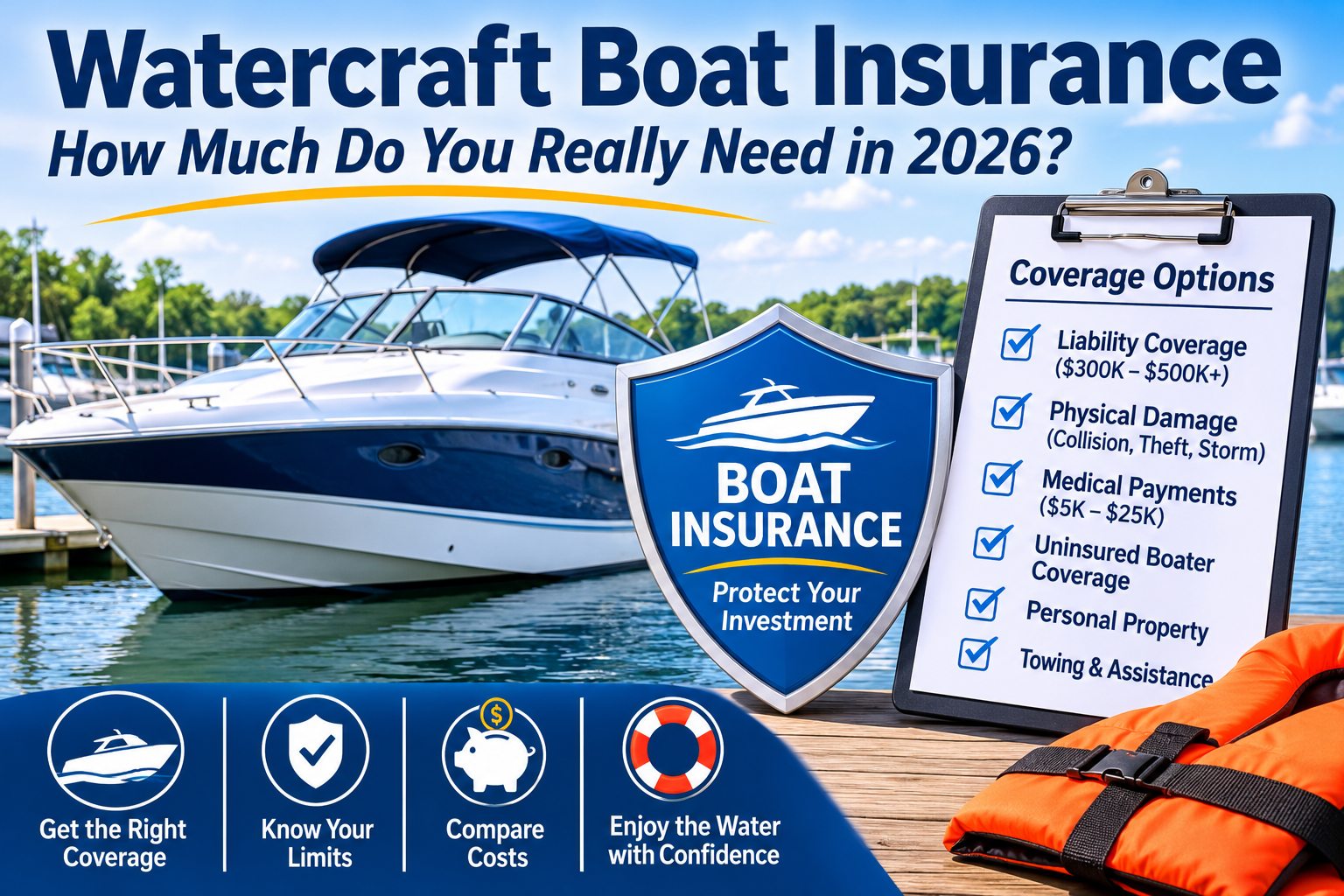
Owning a boat is an exciting way to enjoy the water, whether you use it for fishing, family outings, water sports, or weekend adventures. However, boat ownership also comes with financial responsibilities. Accidents, storms, theft, collisions, and unexpected damage can create expensive problems for boat owners.
One important question every boat owner should ask is: How much watercraft boat insurance do you really need in 2026?
The answer depends on several factors, including your boat’s value, size, horsepower, location, intended use, and financial situation. A small fishing boat may need different protection than a luxury yacht, speedboat, or personal watercraft.
In 2026, choosing the right boat insurance coverage means looking beyond the minimum liability requirements. You should consider protection for your vessel, passengers, other boaters, personal belongings, and potential environmental damage.
This guide explains recommended boat insurance coverage amounts, common policy options, costs, state requirements, and practical ways to choose the right protection. Best Watercraft Boat Insurance near me
1. How Much Boat Insurance Do You Need in 2026?
There is no single insurance amount that works for every boat owner. However, many boat owners consider liability limits of at least $300,000, while those with larger boats or significant assets may want $500,000 to $1 million or more.
These are planning benchmarks, not universal legal requirements or guarantees of adequate protection.
Your coverage should account for the potential cost of an accident and the amount of financial loss you could personally face.
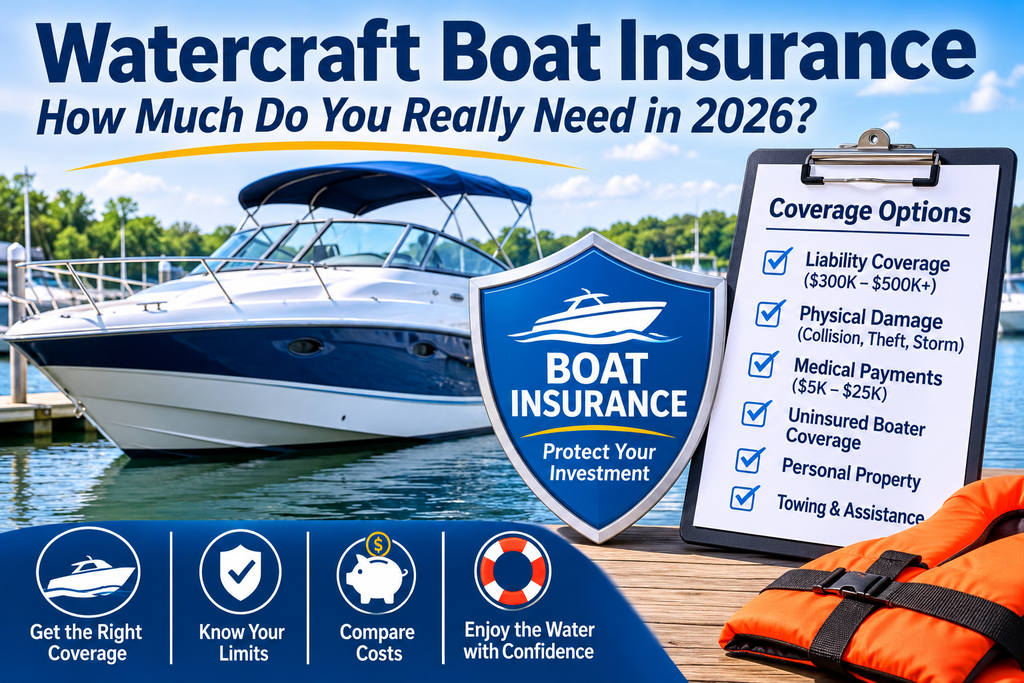
Recommended Boat Insurance Coverage
| Coverage type | Suggested coverage to consider |
|---|---|
| Bodily injury liability | $300,000–$500,000 or more |
| Property damage liability | $100,000–$300,000 or more |
| Medical payments | $5,000–$25,000 |
| Uninsured boater coverage | $100,000–$300,000 |
| Physical damage coverage | Based on boat value |
| Personal property coverage | Based on belongings’ value |
| Emergency assistance | Based on towing and recovery needs |
These amounts are illustrative recommendations. Actual limits, availability, deductibles, and policy terms vary between insurance companies.
2. Understanding the Main Types of Boat Insurance Coverage
Before deciding how much watercraft insurance you need, understand what each coverage option protects.
A. Boat Liability Insurance
Liability insurance is one of the most important parts of a boat insurance policy.
It may cover legal responsibility for injuries or property damage caused to other people during a covered boating accident.
For example, imagine you accidentally collide with another boat while navigating a busy lake. The other vessel suffers significant damage, and several passengers require medical attention.
Without sufficient liability coverage, you could face substantial out-of-pocket expenses.
Recommended consideration: Start by comparing $300,000 and $500,000 liability limits. Consider higher limits if you own an expensive boat, regularly carry passengers, or have significant personal assets.
B. Physical Damage Coverage
Physical damage coverage protects your insured boat against covered damage or loss.
Depending on your policy, it may cover:
- Accidental collisions.
- Fire damage.
- Theft and attempted theft.
- Storm-related damage.
- Vandalism.
- Certain grounding incidents.
The appropriate coverage amount should reflect the boat’s agreed value or actual cash value, depending on the policy.
For example, if your boat is worth $75,000, you should evaluate whether the policy provides sufficient protection to replace or repair it following a covered loss.
C. Medical Payments Coverage
Medical payments coverage can help pay eligible medical expenses for you and your passengers after a covered boating accident, regardless of who was responsible, subject to policy conditions.
It may help with:
- Emergency medical treatment.
- Ambulance services.
- Hospital expenses.
- Certain follow-up medical costs.
Boat owners can compare limits of $5,000, $10,000, and $25,000 to determine what makes sense for their needs. Best Watercraft Boat Insurance near me
D. Uninsured or Underinsured Boater Coverage
Not every boat owner carries adequate insurance. If an uninsured or underinsured boater causes an accident, recovering compensation can become difficult.
Uninsured or underinsured boater coverage may help protect you and eligible passengers against certain injuries caused by another boater who lacks sufficient insurance.
E. Personal Effects Coverage
Many boat owners carry valuable belongings, including:
- Fishing equipment.
- Navigation devices.
- Safety equipment.
- Cameras and electronics.
- Water sports equipment.
- Personal accessories.
Personal effects coverage may protect eligible belongings against covered theft or damage. Check exclusions, special limits, and whether equipment must be listed separately.
3. How Much Boat Insurance Do You Need Based on Your Boat Type?
The right insurance amount also depends on the type of watercraft you own. Different vessels have different risks, replacement costs, and insurance requirements.
Small Fishing Boats
Small fishing boats generally have lower replacement costs than larger recreational vessels. Consider adequate liability coverage, physical damage protection, and coverage for fishing equipment.
Pontoon Boats
Pontoon boats often carry multiple passengers. Consider higher bodily injury liability limits, medical payments, physical damage, and personal belongings coverage.
Speedboats
High-speed vessels may create greater accident risks and more expensive claims. Review liability limits, navigation restrictions, and performance-related exclusions.
Illustrative liability target: $500,000–$1 million or more.
Yachts and Luxury Boats
Expensive vessels may require specialized yacht insurance, higher liability limits, equipment protection, and additional coverage for passengers and crew.
Illustrative liability target: $1 million or more, depending on exposure.
Personal Watercraft and Jet Skis
Jet skis can cause serious injuries and property damage. Consider liability, physical damage, medical payments, and coverage for towing or recovery.
Illustrative liability target: $100,000–$300,000 or more.
These are starting points for comparing insurance options, not mandatory limits. Insurers may apply different underwriting requirements to each type of vessel.
4. Is Boat Insurance Legally Required in the United States?
Boat insurance requirements differ across states. Unlike automobile insurance, there is no universal federal requirement that every recreational boat owner carry liability insurance.
However, certain states, marinas, lenders, and boating facilities may impose specific requirements.
For example:
- California: State law generally does not require recreational boat insurance, but marinas and lenders may require coverage.
- Florida: Recreational boat insurance is generally not mandatory under state law, although financing and marina agreements may require it.
- Texas: Most private recreational boat owners are not subject to a general state insurance mandate.
- New York: Boat insurance is generally not required for every recreational vessel, but particular facilities and lenders may require it.
- Massachusetts: State law does not generally require private recreational boat insurance, although lenders may impose coverage requirements.
California boat owners should also understand that registration and boating safety requirements are separate from insurance requirements. Menlo+2
Important: Always check your state’s current boating regulations and your marina or financing agreement before operating your vessel.
5. Agreed Value vs. Actual Cash Value: Which Is Better?
One of the most important decisions when purchasing boat insurance is choosing how your insurer will calculate compensation after a covered loss.
There are two common valuation methods.
Agreed Value Coverage
Greater value certainty
- You and the insurer agree on the insured vessel value when the policy is issued.
- A covered total loss is generally settled using that agreed amount, subject to policy terms.
- It can be attractive for newer, restored, or higher-value boats.Actual Cash Value Coverage
- Accounts for depreciation when calculating the boat’s value.
- Generally provides a lower settlement than agreed value for an older vessel.
- May have a lower premium.
For example, imagine you insure a boat worth $80,000.
If you choose agreed value coverage for $80,000, a covered total loss may be settled at the agreed amount, subject to the policy conditions.
With actual cash value coverage, the insurer may deduct depreciation, meaning the settlement could be lower.
The Insurance Information Institute explains the differences between these valuation methods and why boat owners should understand their policy’s settlement provisions. Triple-I®+1
6. What Factors Determine How Much Boat Insurance You Need?
Choosing coverage requires evaluating your individual boating risks.
Here are the most important factors.
Boat Value and Replacement Cost
Your boat’s value is a major consideration. A $20,000 fishing boat does not have the same financial exposure as a $200,000 yacht.
Consider the current replacement cost, including permanently attached equipment, engines, and accessories.
Where You Operate Your Boat
Your navigation area can affect both coverage availability and premiums.
For example, operating a boat in coastal waters may create different weather and accident exposures than using it on a small inland lake.
Number of Passengers
If you regularly take family members and friends boating, consider whether your bodily injury liability and medical payments limits are sufficient.
Engine Size and Speed
Boats with powerful engines and higher speeds may carry greater accident exposure. Some insurers also have special restrictions for high-performance vessels.
Storage and Protection
Where you store your boat can influence the risks covered by your policy.
Consider protection for:
- Marina storage.
- Private docks.
- Boat trailers.
- Winter storage.
- Storm and hurricane exposure.
- Theft prevention.
Your Financial Situation
Your personal assets should also influence your liability limits.
If you own a home, investment property, savings, or other valuable assets, an expensive boating accident could create significant financial exposure.
Consider discussing higher liability limits and a personal umbrella policy with your insurance professional. Confirm that the umbrella policy covers your particular watercraft.
7. How Much Does Boat Insurance Cost in 2026?
Boat insurance premiums vary depending on the vessel, location, coverage limits, deductible, and boating history.
A 2026 GEICO insurance guide reports annual boat insurance averages of approximately $300–$650, with location and vessel characteristics affecting pricing. These are broad estimates, not guaranteed quotes or universal market averages. GEICO+1
The following table illustrates how coverage choices can influence insurance expenses.
| Coverage option | General cost consideration |
|---|---|
| Liability only | Usually less expensive |
| Liability + collision | Higher premium |
| Comprehensive coverage | Adds protection and cost |
| Agreed value coverage | May cost more |
| Higher liability limits | Can increase premiums |
| Towing and emergency assistance | Additional cost may apply |
What Can Increase Boat Insurance Premiums?
- Expensive boats and powerful engines.
- Limited boating experience.
- Previous boating accidents or claims.
- Coastal or hurricane-prone locations.
- High-value equipment and accessories.
- Frequent boating or extended navigation areas.
- Lower deductibles and higher coverage limits.
How to Reduce Boat Insurance Costs
You do not necessarily need to sacrifice important coverage to save money.
Consider these practical strategies:
- Compare quotes from multiple insurance providers.
- Complete an approved boating safety course.
- Maintain a clean boating and claims history.
- Install appropriate anti-theft and safety equipment.
- Ask about multi-policy discounts.
- Consider a deductible you can comfortably afford.
- Review seasonal storage and navigation options.
- Remove unnecessary coverage only after evaluating the risks.
The key is to balance affordable premiums with adequate financial protection.
8. Do You Need Additional Boat Insurance Coverage?
Standard boat insurance may not cover every situation. Depending on your vessel and activities, additional protection may be useful.
Boat Towing and Emergency Assistance
A boat breakdown can leave you stranded far from shore or a marina. Towing coverage may help with eligible emergency towing and assistance expenses.
Hurricane and Storm Protection
Boat owners in coastal regions should carefully review storm coverage, named-storm deductibles, haul-out requirements, and hurricane preparation conditions.
Fishing Equipment Coverage
If you own expensive fishing rods, electronics, tackle, or specialized equipment, consider additional personal effects coverage.
Boat Trailer Coverage
Your boat trailer may need separate or specifically included physical damage protection. Verify whether your policy covers the trailer while stored, transported, or parked.
Pollution and Fuel Spill Liability
An accident involving fuel leakage or other pollution can create cleanup costs and legal responsibilities. Ask whether your policy includes pollution liability and what exclusions or limits apply.
Personal Umbrella Insurance
An umbrella policy can provide additional liability protection above eligible underlying insurance limits. However, watercraft eligibility, minimum underlying limits, and exclusions vary.
9. How to Calculate the Right Amount of Boat Insurance
You can use a simple process to estimate how much coverage you should consider.
Boat insurance coverage plannerEstimated boat value (USD)Liability limit to consider$100,000$300,000$500,000$1 millionWatercraft type
Recreational boatDo you regularly carry passengers?YesNo / Rarely
Review my coverage needsEducational planning tool only. It does not calculate premiums, determine legal requirements, or replace an insurer’s assessment.
When calculating coverage, consider the following:
- The cost of replacing your boat.
- Potential injuries to passengers or other people.
- Damage to other boats, docks, and property.
- The value of equipment and personal belongings.
- Emergency towing and recovery expenses.
- Your existing liability and umbrella insurance.
A licensed insurance professional can help translate these risks into suitable policy limits.
10. Common Boat Insurance Mistakes to Avoid in 2026
Many boat owners purchase insurance without fully understanding their policy. Avoid these common mistakes:
- Choosing insufficient liability coverage: A low limit may not cover serious injuries or expensive property damage.
- Ignoring boat replacement value: Your boat’s current market value may differ significantly from its replacement cost.
- Assuming homeowners insurance is enough: Homeowners policies often provide limited watercraft protection and may exclude important liability risks. Triple-I®+1
- Overlooking passenger protection: Medical payments and uninsured boater coverage deserve attention.
- Ignoring storm exclusions: Review hurricane, flood, and named-storm provisions carefully.
- Forgetting trailer and equipment coverage: Confirm that accessories, electronics, and trailers are adequately insured.
- Not reviewing insurance annually: Changes in boat value, usage, and navigation areas may require updated coverage.
11. Boat Insurance Checklist: What Should Your Policy Include?
Before purchasing or renewing your watercraft insurance policy, review this checklist.
- Adequate bodily injury liability protection.
- Sufficient property damage liability.
- Physical damage coverage for your boat.
- Appropriate agreed value or actual cash value settlement.
- Medical payments coverage.
- Uninsured or underinsured boater coverage.
- Personal belongings and fishing equipment protection.
- Boat trailer coverage.
- Emergency towing and assistance.
- Storm and hurricane coverage where applicable.
- Appropriate navigation limits.
- Deductibles you can afford.
- Coverage that satisfies lender and marina requirements.
Not every policy includes all these protections automatically. Confirm each coverage and its exclusions with your insurance provider.
Conclusion: How Much Watercraft Boat Insurance Do You Really Need in 2026?
The amount of watercraft insurance you need in 2026 depends on your boat’s value, boating activities, location, passengers, and financial exposure.
For many recreational boat owners, comparing $300,000–$500,000 in liability protection is a reasonable starting point. Owners of expensive yachts, high-performance boats, or vessels carrying multiple passengers may need substantially higher limits.
Remember that liability insurance protects against certain claims involving other people and their property, while physical damage coverage protects your own vessel against covered losses.
Rather than choosing the cheapest policy, compare insurance limits, exclusions, deductibles, valuation methods, and additional benefits.
The right boat insurance policy should protect your financial investment and help you enjoy the water with greater confidence throughout 2026.
Frequently Asked Questions (FAQs)
1. How much boat insurance do I need in 2026?
Many boat owners consider at least $300,000–$500,000 in liability coverage. The appropriate amount depends on the boat’s value, passenger exposure, boating activities, and personal financial circumstances.
2. Is boat insurance mandatory in the United States?
There is no general federal requirement for all recreational boats to carry insurance. However, certain state rules, lenders, marinas, and boating facilities may impose insurance requirements.
3. Is $300,000 enough boat liability insurance?
It may be sufficient for some recreational boat owners, but serious accidents can result in higher claims. Consider $500,000 or $1 million limits if your financial exposure warrants additional protection.
4. Does boat insurance cover storm damage?
Many comprehensive boat policies cover certain storm-related losses, but exclusions, hurricane restrictions, named-storm deductibles, and navigation limitations can apply.
5. Does homeowners insurance cover my boat?
Some homeowners policies provide limited coverage for small boats. However, they may not adequately cover larger vessels, boat liability, or expensive equipment.
6. What is the difference between agreed value and actual cash value boat insurance?
Agreed value coverage uses a value established with the insurer when the policy is issued. Actual cash value coverage accounts for depreciation when calculating a covered loss.
7. Does boat insurance cover passengers?
Depending on the policy, medical payments and liability coverage may protect eligible passengers against certain injury-related expenses and claims.
8. Do I need separate insurance for a jet ski?
A separate personal watercraft policy or a specific personal watercraft coverage arrangement may be appropriate. Check whether your existing boat policy covers the jet ski and its intended use.
9. How can I get cheaper boat insurance in 2026?
Compare multiple quotes, maintain a good boating record, complete approved safety courses, ask about discounts, and choose deductibles that fit your budget.
10. Should I get $1 million boat insurance coverage?
Higher liability limits may be appropriate for expensive boats, high-risk activities, frequent passengers, and owners with substantial assets. An umbrella policy may also provide additional protection if watercraft liability is eligible.