
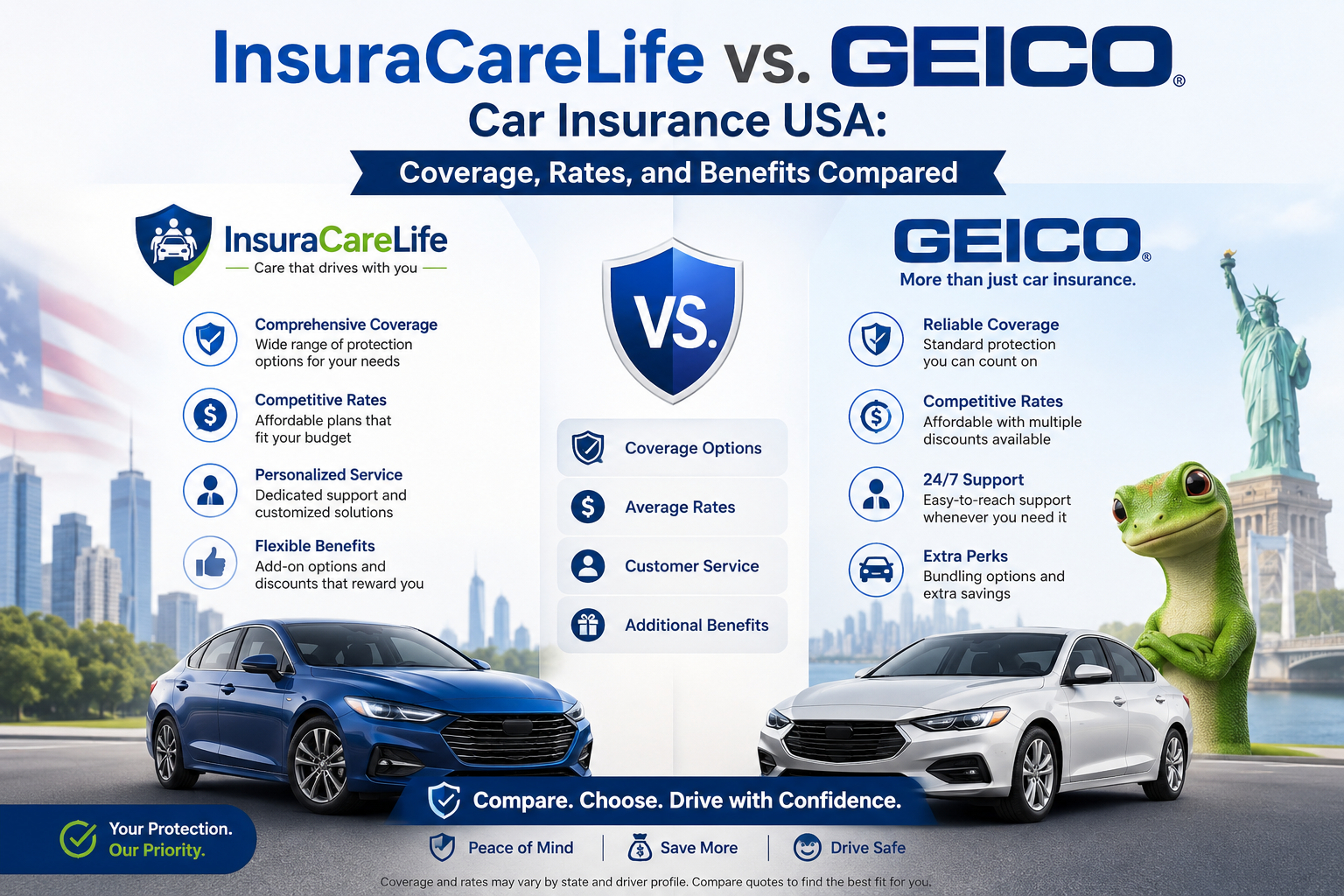
Choosing the right car insurance in the United States can be challenging. Drivers have dozens of insurers, coverage options, deductibles, discounts, and pricing factors to consider. Two names that may come up during an insurance comparison are InsuraCareLife and GEICO.
This guide explains how to compare InsuraCareLife and GEICO car insurance based on the factors that matter most to American drivers, including coverage, rates, discounts, benefits, customer service, claims, flexibility, and overall value.
One important point should be made at the beginning: car insurance coverage and pricing vary by state, driver, vehicle, insurer, underwriting company, and policy terms. GEICO publicly provides detailed information about its auto insurance products and discounts. I could not independently verify a comparable public U.S. auto-insurance product portfolio for InsuraCareLife from authoritative sources, so specific InsuraCareLife coverage, rates, discounts, and claims features should be confirmed directly from its current policy documents and quote process rather than assumed.
Understanding Car Insurance in the United States
Before comparing two insurance providers, it is important to understand what you are actually buying.
Auto insurance generally provides financial protection against losses involving your vehicle, injuries, property damage, theft, accidents, and other covered events. Most states require drivers to maintain at least certain minimum insurance coverage, although the required limits and rules differ by state.
The National Association of Insurance Commissioners explains that auto insurance pricing is based largely on underwriting and rating. Insurers evaluate risk and then calculate a premium based on factors such as location, driving record, vehicle type, coverage choices, claims history, and other characteristics.
This means there is no single insurer that will always be cheapest for every driver.
A company that offers a low quote to one driver may offer a significantly higher quote to another. Therefore, the best InsuraCareLife vs. GEICO comparison should be based on your actual quotes with equivalent coverage limits and deductibles.
InsuraCareLife vs. GEICO: Quick Comparison
| Comparison Factor | InsuraCareLife | GEICO |
|---|---|---|
| U.S. auto insurance availability | Verify by state and policy | Broad U.S. availability, subject to state/company rules |
| Liability coverage | Verify current policy options | Available |
| Collision coverage | Verify current policy options | Available |
| Comprehensive coverage | Verify current policy options | Available |
| Uninsured/underinsured motorist | Verify by state/policy | Available where applicable |
| Rental reimbursement | Verify current policy options | Available |
| Roadside assistance | Verify current policy options | Emergency Roadside Service available |
| Mechanical breakdown insurance | Verify availability | Available |
| Discounts | Verify eligibility | Multiple discount programs |
| Telematics | Verify availability | DriveEasy available in eligible areas |
| Online quoting | Verify current process | Available |
| Mobile/online account management | Verify current features | Available |
| Pricing | Individual quote required | Individual quote required |
The table illustrates an important difference: GEICO’s publicly documented offerings can be verified directly, while InsuraCareLife’s current product details should be confirmed before making specific claims about coverage or savings.
1. Coverage Comparison
Coverage should be the first consideration when comparing car insurance.
A low premium is not necessarily a good deal if it provides substantially less protection.
Liability Insurance
Liability insurance generally protects you financially when you are legally responsible for injuries to another person or damage to another person’s property.
Most states require liability coverage, but the minimum limits vary.
For example, a policy might contain separate bodily injury and property damage limits. Drivers should consider whether state minimums provide enough protection for their financial situation.
When comparing InsuraCareLife and GEICO, make sure the liability limits are identical in both quotes.
Do not compare a $25,000/$50,000 liability policy with a $100,000/$300,000 policy and conclude that the cheaper quote is automatically better.
Collision Coverage
Collision coverage can help pay for damage to your insured vehicle resulting from a collision with another vehicle or object, subject to the policy deductible and terms.
GEICO lists collision coverage among its auto insurance options.
If InsuraCareLife offers collision coverage, compare:
- Deductible
- Covered loss conditions
- Vehicle valuation
- Exclusions
- Claims procedures
- Repair-related provisions
For a financed or leased vehicle, collision coverage may be required by the lender.
Comprehensive Coverage
Comprehensive coverage generally protects against qualifying damage that is not caused by a collision. Depending on the policy, covered events can include theft, vandalism, hail, flooding, fire, and animal strikes.
GEICO describes comprehensive insurance as optional coverage that can help cover these types of losses.
When comparing policies, look beyond the premium. A $500 deductible and a $1,500 deductible can produce very different out-of-pocket costs after a covered loss.
Uninsured and Underinsured Motorist Coverage
Another important consideration is protection against drivers who have no insurance or insufficient insurance.
GEICO states that uninsured motorist coverage can help with certain vehicle repair and medical expenses when an uninsured driver causes an accident. Availability and details vary by state and policy.
If you are comparing InsuraCareLife and GEICO, check whether both policies offer comparable uninsured and underinsured motorist protection.
2. Additional Coverage Options
Beyond basic liability, collision, and comprehensive insurance, drivers may want additional protection.
GEICO publicly lists options such as:
- Emergency Roadside Service
- Rental reimbursement
- Mechanical breakdown insurance
Availability depends on the applicable state and policy.
InsuraCareLife customers should verify whether similar options are available and whether they are included automatically or purchased separately.
Rental Reimbursement
Rental reimbursement can help pay eligible rental-car expenses after a covered loss, subject to daily and maximum limits.
For someone who depends on a vehicle for work, school, or family responsibilities, this benefit can be particularly useful.
Roadside Assistance
Roadside assistance may help with situations such as a breakdown, flat tire, lockout, or dead battery, depending on the policy.
Compare not only the price of roadside assistance but also the services, limits, and circumstances under which benefits apply.
3. Comparing Car Insurance Rates
Price is one of the biggest reasons drivers compare insurance companies.
However, it is impossible to say that InsuraCareLife or GEICO will always be cheaper for every U.S. driver.
The NAIC notes that premiums can be affected by factors including location, age, driving experience, driving record, claims history, credit history where permitted, vehicle type, vehicle use, mileage, coverage selections, and deductibles.
GEICO similarly explains that factors such as driving history, vehicle type, and location influence auto insurance pricing.
Why Your Quote May Be Different From Someone Else’s
Consider two drivers:
Driver A
- 45 years old
- Clean driving record
- Drives an older sedan
- Lives in a lower-risk area
- Drives relatively few miles
Driver B
- 20 years old
- Has a recent speeding ticket
- Drives a newer sports-oriented vehicle
- Lives in a densely populated area
- Drives many miles each year
Even if both drivers request the same insurer, their premiums could be dramatically different.
That is why an InsuraCareLife vs. GEICO comparison should use personalized quotes rather than average prices alone.
4. GEICO Discounts
One of GEICO’s notable advantages is the range of publicly documented discounts and savings opportunities.
GEICO lists discounts associated with factors such as vehicle equipment, safe driving, driver education, good students, multiple vehicles, policy bundling, homeowners, early shopping, paperless billing, automatic payments, and other eligibility factors.
GEICO also offers its DriveEasy program in eligible areas, which uses driving information to potentially reward safer driving behavior.
The exact discount and eligibility requirements vary by state and policy.
If InsuraCareLife offers discounts, compare them carefully. A discount percentage by itself does not tell you which insurer provides the better deal.
For example, suppose:
- InsuraCareLife base premium = $1,500
- Discount = 15%
- Final premium = $1,275
And:
- GEICO base premium = $1,350
- Discount = 10%
- Final premium = $1,215
In this example, the insurer offering the smaller discount produces the lower final price.
Always compare the final premium, not just the advertised discount.
5. Customer Service and Digital Convenience
Modern drivers increasingly want to manage insurance online.
Online services can make it easier to:
- Request a quote
- View policy documents
- Make payments
- Update information
- Add vehicles
- Review coverage
- Start or manage a claim
- Access insurance cards
GEICO provides online quoting and account-management tools, and it also offers access to local agents.
For InsuraCareLife, prospective customers should check the current availability of online account management, mobile services, agent support, and customer-service channels.
Convenience can become particularly important after an accident, when quick access to policy information and claims assistance may matter more than a small difference in premium.
6. Claims Experience Matters
Insurance is ultimately about protection when something goes wrong.
A company may offer an attractive price, but drivers should also consider how claims are handled.
Before selecting either provider, investigate:
- How claims are reported
- Whether claims can be started online
- Whether claims can be reported through an app
- Availability of claims representatives
- Repair-shop processes
- Rental-car assistance
- Communication during the claims process
- Policyholder reviews and complaint information
Do not judge an insurer solely by advertising or price.
The actual policy contract determines what is covered, subject to its terms, limits, conditions, and exclusions.
7. Deductibles and Their Effect on Price
Your deductible is the amount you generally pay toward a covered claim before the insurer pays the remaining eligible amount.
For example, suppose your covered vehicle damage is $5,000 and your applicable deductible is $1,000.
If the entire $5,000 is covered, you could generally be responsible for the first $1,000, with the insurer paying the remaining eligible amount.
A higher deductible may reduce your premium, but it also means more out-of-pocket expense if you file a claim.
When comparing InsuraCareLife and GEICO, request quotes using the same deductible.
For example:
Comparison A
- InsuraCareLife: $500 deductible
- GEICO: $1,000 deductible
This is not an apples-to-apples comparison.
Instead:
Comparison B
- InsuraCareLife: $500 deductible
- GEICO: $500 deductible
Now the premium difference becomes much more meaningful.
8. State Requirements Matter
Car insurance is regulated at the state level, so a policy that works for a driver in California may not be identical to one available in Texas, Florida, New York, or another state.
The NAIC notes that states have different insurance requirements and that drivers should understand the rules applicable to their location.
Some states use different insurance systems and may have different requirements concerning liability, personal injury protection, uninsured motorists, or other coverages.
Therefore, when comparing InsuraCareLife vs. GEICO in the United States, always identify your state first.
9. Which Is Better for Budget-Conscious Drivers?
For budget-conscious drivers, the goal should not simply be finding the lowest advertised price.
The better objective is finding the lowest reasonable total cost for the protection you actually need.
GEICO offers several documented discounts and savings opportunities, including multi-vehicle, policy-bundling, good-student, military/federal employee, safe-driving, and other programs depending on eligibility and location.
InsuraCareLife should be evaluated using the same criteria:
- Start with the same coverage limits.
- Use the same deductibles.
- Apply all eligible discounts.
- Compare the final six-month or annual premium.
- Review additional coverage.
- Check payment fees.
- Review exclusions and policy conditions.
- Consider claims and customer-service features.
This approach gives you a much more accurate comparison.
10. Which Insurer Offers Better Benefits?
Benefits can mean different things to different drivers.
A young driver might prioritize a good-student discount and telematics.
A family might value multi-vehicle and bundling savings.
A commuter might care about roadside assistance and rental reimbursement.
A driver with a new vehicle might prioritize comprehensive and collision protection.
A driver with an older vehicle may prefer a simpler liability-focused policy if appropriate for their circumstances.
GEICO’s publicly available information shows a broad range of coverage and savings features, but availability can vary by state and GEICO company.
For InsuraCareLife, consumers should verify the specific benefits available under the policy being quoted.
11. How to Compare InsuraCareLife and GEICO Correctly
Use this checklist before making a decision.
Step 1: Get Both Quotes
Obtain a quote from InsuraCareLife and GEICO based on the same driver, vehicle, address, and usage information.
Step 2: Match Coverage Limits
Make sure both quotes use the same:
- Bodily injury limits
- Property damage limits
- Uninsured/underinsured motorist limits
- Collision coverage
- Comprehensive coverage
- Medical-related coverage where applicable
- Optional protections
Step 3: Match Deductibles
Use the same deductible for collision and comprehensive coverage.
Step 4: Compare Discounts
Ask each insurer which discounts you qualify for.
Step 5: Compare Final Prices
Look at the actual premium after discounts rather than the starting price.
Step 6: Review the Policy
Read the declarations page, coverage limits, exclusions, conditions, and endorsements before purchasing.
Step 7: Consider Service
Price is important, but so are claims support, customer service, digital tools, and accessibility.
12. Pros and Cons of GEICO
Potential Advantages
- Broad U.S. presence
- Multiple auto coverage options
- Numerous publicly documented discounts
- Online quoting
- Digital account-management tools
- DriveEasy telematics program in eligible areas
- Roadside assistance
- Rental reimbursement
- Mechanical breakdown insurance
GEICO’s own comparison guidance emphasizes comparing identical coverage levels and reviewing discounts before choosing a policy.
Potential Considerations
- Discounts and coverage options vary by state
- Your quote may not be the same as another driver’s
- A low advertised rate does not guarantee the lowest personalized premium
- Policy terms and exclusions must be reviewed carefully
13. Pros and Cons of InsuraCareLife
Because current, authoritative public information about InsuraCareLife’s U.S. auto insurance products was not available in the sources reviewed for this article, consumers should verify its offerings before relying on specific advertised benefits.
Potential Questions to Ask
- Is auto insurance currently offered in my state?
- Which insurance company underwrites the policy?
- What liability limits are available?
- Are collision and comprehensive coverage available?
- What deductibles can I choose?
- Are uninsured and underinsured motorist protections available?
- Is roadside assistance available?
- Is rental reimbursement available?
- Which discounts apply to my situation?
- How are claims reported?
- Is 24/7 claims assistance available?
- What exclusions apply?
- What is the final premium after all discounts?
These questions help ensure that an InsuraCareLife quote can be compared fairly with a GEICO quote.
14. The Importance of Comparing Policies, Not Just Companies
One of the biggest mistakes consumers make is asking, “Which company is cheapest?”
The better question is:
“Which company gives me the protection I need at the best overall price?”
The cheapest policy may have lower limits, higher deductibles, fewer optional benefits, or restrictions that make it less valuable.
The NAIC recommends shopping around and obtaining comparable premium quotations using the same information and coverage requirements.
This principle is especially important when comparing two insurers.
Final Verdict: InsuraCareLife vs. GEICO Car Insurance USA
There is no universal winner between InsuraCareLife and GEICO because insurance pricing and coverage depend heavily on the individual driver.
GEICO may appeal to drivers who want a well-documented range of auto insurance options, discounts, digital tools, and additional coverage features. Its official materials describe liability, collision, comprehensive, uninsured motorist, roadside assistance, rental reimbursement, mechanical breakdown insurance, and multiple discount opportunities.
InsuraCareLife should be evaluated based on its current state-specific policy offerings, underwriting company, coverage limits, discounts, claims process, and personalized quote. Those details should be confirmed directly before presenting InsuraCareLife as cheaper, more comprehensive, or better than GEICO.
For U.S. drivers, the smartest strategy is simple: compare equivalent coverage, match deductibles, apply every eligible discount, examine the final premium, and read the policy before buying.
A good car insurance policy is not necessarily the cheapest one. It is the policy that provides appropriate protection, useful benefits, reliable claims support, and a premium that fits your budget.
Before purchasing either policy, verify current availability, rates, coverage, and terms for your state. Insurance policies are contracts, and the policy documents—not general website descriptions—control the actual coverage provided.
FAQs: InsuraCareLife vs. GEICO Car Insurance USA
1. Is InsuraCareLife or GEICO cheaper for car insurance?
There is no universal answer. Car insurance rates depend on factors such as location, age, driving record, vehicle, mileage, claims history, coverage limits, and deductibles. The NAIC recommends comparing quotes using the same coverage information.
2. Which offers better car insurance coverage, InsuraCareLife or GEICO?
The better policy depends on the coverage and limits available to you. When comparing InsuraCareLife and GEICO, check liability, collision, comprehensive, uninsured/underinsured motorist, medical coverage, roadside assistance, and rental reimbursement options. Always compare equivalent limits and deductibles.
3. Does GEICO offer discounts?
Yes. GEICO lists discounts for eligible drivers involving safe driving, vehicle equipment, driver education, multiple vehicles, multiple policies, good students, payment options, and other factors. Discount availability varies by state and individual circumstances.
4. Does InsuraCareLife offer car insurance discounts?
You should verify InsuraCareLife’s current discounts directly when requesting a quote. Ask whether discounts are available for safe driving, multiple vehicles, bundling, students, defensive driving, automatic payments, or other qualifying factors.
5. What types of car insurance should I compare?
At minimum, compare bodily injury liability, property damage liability, uninsured/underinsured motorist coverage where applicable, collision, and comprehensive coverage. Optional protections can include rental reimbursement and roadside assistance.
6. Is comprehensive insurance the same as collision coverage?
No. Collision coverage generally addresses damage to your vehicle resulting from a collision. Comprehensive coverage generally addresses qualifying non-collision losses such as theft, fire, hail, flooding, vandalism, or animal impact.
7. Should I choose the lowest car insurance premium?
Not necessarily. A cheaper policy may provide lower liability limits, higher deductibles, or fewer optional benefits. The best value is usually the policy that provides appropriate protection at a price you can afford.
8. How can I compare InsuraCareLife and GEICO fairly?
Request quotes using the same driver information, vehicle, coverage limits, deductibles, and optional benefits. Then compare the final premium after discounts. The NAIC specifically recommends providing the same information when obtaining quotes from different insurers.
9. Can my location affect my car insurance rate?
Yes. Location is one of the factors insurers can consider when determining premiums. Moving to another state or even another rating area can change your rate because insurance requirements and risk factors vary by location.
10. Does my driving record affect my insurance price?
Yes. Driving experience, driving record, and claims history can affect premiums. Safe-driving programs and discounts may also provide savings for eligible drivers.
11. Does GEICO offer online insurance services?
Yes. GEICO provides online account services and a mobile app that can support functions such as managing policies, accessing insurance information, making payments, and handling certain claims-related tasks.
12. What should I check before buying InsuraCareLife car insurance?
Check the insurer and policy’s availability in your state, coverage limits, deductibles, exclusions, discounts, claims process, customer-service options, payment terms, and the final quoted premium. Also confirm who actually underwrites the policy.
13. Does GEICO offer roadside assistance?
GEICO offers Emergency Road Service, although specific availability and terms can depend on the applicable policy and state.
14. Can I change my deductible to reduce my premium?
Generally, selecting a higher deductible can reduce the premium, but it also means you may have to pay more out of pocket after a covered claim. Compare the premium savings against the additional financial risk.
15. Is GEICO a good choice for U.S. drivers?
GEICO can be a strong option for drivers who value its broad range of auto insurance options, discounts, online services, and additional features. However, whether it is the best choice depends on your individual quote and coverage needs.
16. Is InsuraCareLife better than GEICO?
There is no one-size-fits-all answer. Compare the two based on coverage, final premium, deductibles, discounts, claims support, policy terms, and customer service rather than choosing based only on the company name.
17. How many car insurance quotes should I get?
Getting multiple quotes can help you understand whether you are receiving a competitive price. The NAIC consumer shopping guidance recommends contacting more than one insurer and comparing quotes.
18. What is the most important factor when comparing InsuraCareLife and GEICO?
The most important factor is overall value. Look for a combination of adequate coverage, affordable premiums, reasonable deductibles, useful benefits, reliable claims handling, and policy terms that meet your needs.
19. Can insurance rates change after I purchase a policy?
Yes. Premiums can change at renewal or after changes to your circumstances, such as moving, adding a vehicle or driver, making a claim, or receiving a driving violation. State regulations and insurer rating practices can also affect premiums.
20. What is the final takeaway when comparing InsuraCareLife and GEICO?
Don’t choose based solely on the lowest advertised rate. Get comparable quotes, match coverage limits and deductibles, apply eligible discounts, examine exclusions and benefits, and review the actual policy documents before purchasing. This gives you a more meaningful InsuraCareLife vs. GEICO car insurance comparison.