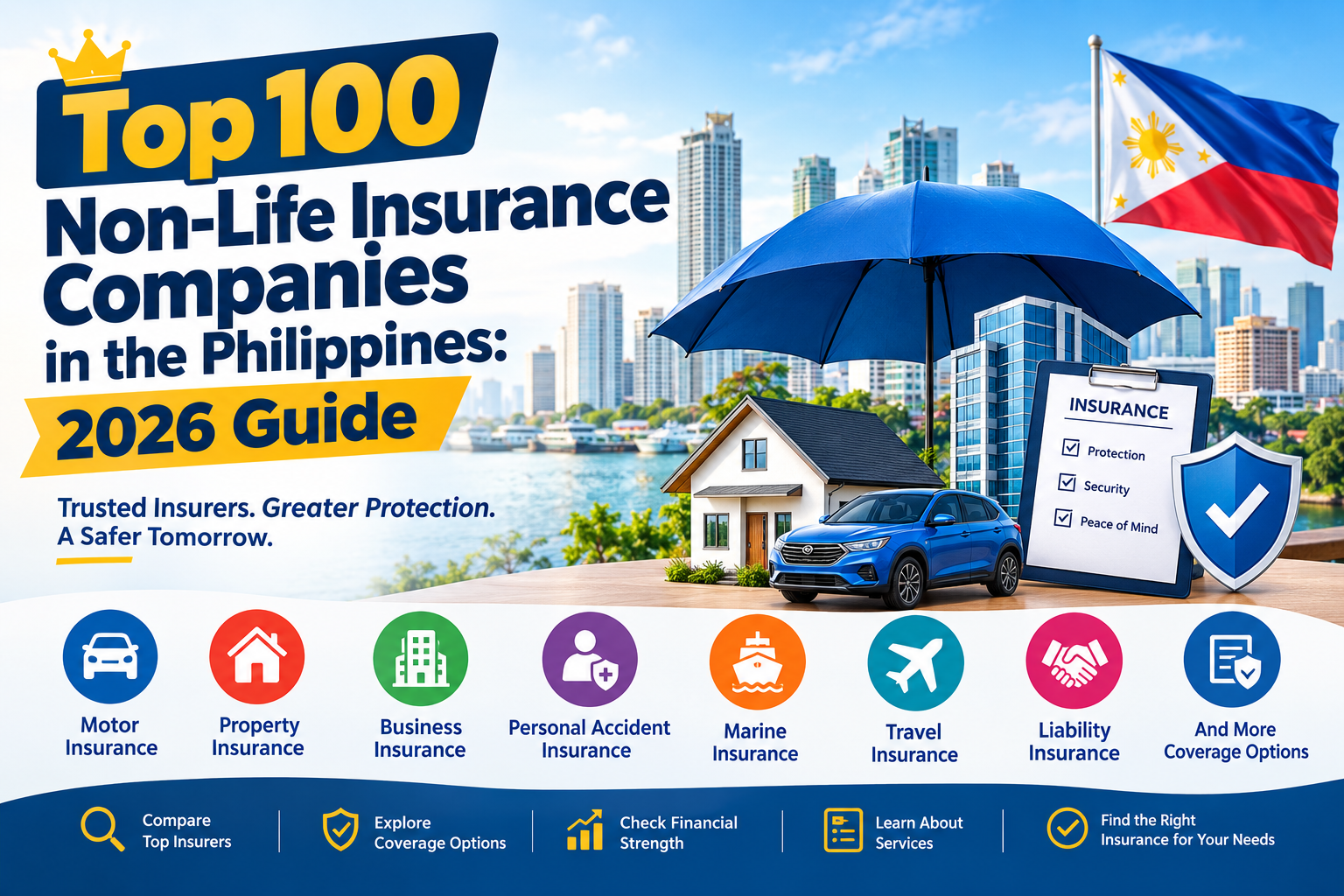
The Philippine insurance market continues to evolve as consumers, businesses, vehicle owners, property owners, and organizations look for reliable protection against financial losses. Non-life insurance plays an important role in this market by providing coverage for automobiles, homes, businesses, property, travel, marine risks, accidents, surety obligations, and other general insurance needs.
This Top 100 Non-Life Insurance Companies in the Philippines: 2026 Guide provides an overview of the leading names in the country’s non-life insurance sector and explains what consumers should consider when choosing an insurer.
For accuracy, this guide uses the latest available year-end information from the Philippine Insurance Commission (IC). Its December 31, 2025 asset report contains 54 companies/entities in the submitted non-life statistics, including standalone non-life insurers and composite insurers whose non-life operations are reported separately. Therefore, the list below should not be interpreted as an official Insurance Commission “Top 100” ranking. Instead, it is a comprehensive 2026 guide based primarily on reported assets and current regulatory information.
Philippine Non-Life Insurance Industry in 2026
The non-life insurance industry entered 2026 with continued growth. According to the Insurance Commission, the sector’s total assets reached approximately ₱391.79 billion as of December 31, 2025 when the reported non-life companies, professional reinsurer, and servicing companies were included. The non-life company subtotal was approximately ₱369.58 billion.
The industry also recorded strong premium activity during 2025. At the end of September 2025, total net premiums written reached approximately ₱60.07 billion, representing a 13.07% increase compared with the same period in 2024. Motor insurance remained the largest business line, followed by fire, accident, other casualty, suretyship, health, and marine and aviation insurance.
During the first half of 2025, net premiums written increased 20.48% year over year to approximately ₱39.63 billion. Motor-car insurance accounted for 40.52% of total net premiums written during that period.
These figures demonstrate why non-life insurance remains an important component of financial planning in the Philippines.
Leading Non-Life Insurance Companies in the Philippines
The following companies appear in the Insurance Commission’s December 31, 2025 non-life asset report. The order below follows the Commission’s reported asset ranking rather than an independent editorial ranking.
1–10
- Pioneer Insurance & Surety Corporation
- Malayan Insurance Company, Inc.
- Prudential Guarantee and Assurance, Inc.
- BPI/MS Insurance Corporation
- Standard Insurance Company, Inc.
- Stronghold Insurance Company, Inc.
- Starr International Insurance Philippines Branch
- AXA Philippines Life and General Insurance Corporation
- FPG Insurance Co., Inc.
- Alliedbankers Insurance Corporation
Pioneer Insurance & Surety Corporation ranked first in the Commission’s December 2025 asset table, with reported assets of approximately ₱57.91 billion. Malayan Insurance followed with approximately ₱33.52 billion, while Prudential Guarantee and Assurance reported approximately ₱24.89 billion.
11–20
- Petrogen Insurance Corporation
- AIG Philippines Insurance, Inc.
- PGA Sompo Insurance Corporation
- Paramount Life & General Insurance Corporation
- Insurance Company of North America
- Mercantile Insurance Company, Inc.
- MAAGAP Insurance Inc.
- COCOGEN Insurance, Inc.
- Travellers Insurance & Surety Corporation
- Commonwealth Insurance Company
These companies represent a mixture of established Philippine insurers, international insurance operations, and composite companies with non-life businesses. The Insurance Commission’s data shows that the sector has a relatively broad competitive structure rather than being dominated by only a handful of providers.
21–30
- M Pioneer Insurance Inc.
- Alpha Insurance & Surety Company, Inc.
- Liberty Insurance Corporation
- Philippine British Assurance Company, Inc.
- Oona Insurance Corporation
- CARD Pioneer Microinsurance, Inc.
- Visayan Surety & Insurance Corporation
- Bethel General Insurance & Surety Corporation
- Milestone Guaranty & Assurance Corporation
- Sterling Insurance Company, Inc.
These insurers participate in different segments of the Philippine non-life market, including motor, property, casualty, surety, microinsurance, and other forms of general insurance.
31–40
- Philippines First Insurance Company, Inc.
- Pacific Union Insurance Company
- Pacific Cross Insurance, Inc.
- Cibeles Insurance Corporation
- Asia Insurance (Philippines) Corporation
- Western Guaranty Corporation
- Pioneer Intercontinental Insurance Corporation
- The Premier Life and General Assurance Corporation
- Asia United Insurance, Inc.
- Fortune General Insurance Corporation
The Insurance Commission reported assets ranging from approximately ₱3.98 billion for Philippines First Insurance to approximately ₱2.90 billion for Fortune General Insurance among companies in this section of the ranking.
41–50
- SeaInsure General Insurance Co., Inc.
- CLIMBS Life & General Insurance Cooperative
- Intra-Strata Assurance Corporation
- Corporate Guarantee & Insurance Company, Inc.
- SGI Philippines General Insurance Company, Inc.
- Country Bankers Insurance Corporation
- Metropolitan Insurance Company, Inc.
- Perla Compañia de Seguros, Inc.
- 1 Cooperative Insurance System of the Philippines Life & General Insurance
- AIA Philippines Life and General Insurance Company, Inc.
The final companies in the Commission’s asset table include composite insurers. Composite insurers conduct both life and non-life business, so their inclusion is specifically identified in the Commission’s statistics.
51–54
- Etiqa Life and General Assurance Philippines, Inc.
- Manila Bankers Life and General Corporation
- Country Bankers Life and General Insurance Corporation
- People’s General Insurance Corporation
The Insurance Commission marked Country Bankers Life and General Insurance Corporation as having no business yet in the December 2025 asset report, while People’s General Insurance Corporation was identified as having not submitted the relevant report. Consequently, asset-based comparisons should not treat those two entries as equivalent to companies with reported figures.
Why Non-Life Insurance Matters
Non-life insurance protects people and organizations against financial losses that can result from unexpected events. Unlike life insurance, which generally focuses on death benefits and long-term financial protection, non-life insurance covers assets, liabilities, accidents, property, vehicles, businesses, and other risks.
Some of the most common forms include:
Motor Insurance
Motor insurance is one of the largest segments of the Philippine non-life market. It can provide financial protection against vehicle damage, theft, third-party liability, accidents, and other covered risks.
The Insurance Commission reported that motor-car insurance represented 40.52% of total net premiums written during the first half of 2025.
Property Insurance
Property insurance can help protect homes, buildings, commercial facilities, equipment, and other physical assets against covered events such as fire, certain natural disasters, theft, and other specified risks.
Business Insurance
Businesses can purchase various forms of non-life insurance to protect property, vehicles, equipment, employees, customers, and financial interests. Commercial property, liability, marine, surety, and other specialized policies can be particularly important for companies with significant operational risks.
Accident Insurance
Personal accident coverage can provide benefits following qualifying accidents, depending on the policy. Coverage may include accidental death, disability, medical expenses, or other benefits.
Marine and Aviation Insurance
Marine insurance can protect cargo, vessels, and transportation-related interests against specified risks. Aviation insurance provides specialized protection for aircraft and aviation-related liabilities.
Surety Insurance
Surety products can support contractual and financial obligations. They are commonly relevant to construction projects, government contracts, commercial transactions, and other situations where guarantees are required.
Travel Insurance
Travel insurance can provide protection for certain unexpected events during domestic or international trips. Depending on the policy, benefits may include medical emergencies, trip interruption, baggage-related losses, and other covered events.
How to Choose a Non-Life Insurance Company
Choosing an insurer should involve more than simply selecting the company with the lowest premium.
1. Check Regulatory Status
Consumers should verify that the insurer is authorized to operate in the Philippines. The Insurance Commission publishes lists of insurance companies with valid and existing Certificates of Authority. Its December 31, 2025 list distinguishes composite, life, and non-life companies.
2. Compare Coverage
Two policies with similar prices may provide very different levels of protection. Compare insured risks, exclusions, deductibles, limits, optional benefits, and claim conditions.
3. Consider Financial Strength
Company size and reported assets can provide useful context, although assets alone should not be treated as a complete measure of an insurer’s quality. Consumers can also consider financial performance, capitalization, claims experience, and regulatory information.
4. Review the Claims Process
An insurance policy becomes especially valuable when a claim needs to be filed. Before buying coverage, find out how claims are submitted, what documents are required, where claims can be reported, and how the insurer communicates with policyholders.
5. Compare Premiums
Price remains important, but the cheapest policy is not necessarily the best policy. A low premium may come with lower coverage limits, higher deductibles, more exclusions, or fewer optional benefits.
6. Look at Customer Service
Accessibility matters. Consumers should consider whether the insurer offers convenient customer service, online services, mobile tools, branch support, and multiple ways to report claims or request assistance.
What to Compare Between Philippine Insurers
When comparing non-life insurance companies, consumers can create a simple checklist:
| Factor | What to Compare |
|---|---|
| Regulatory authorization | Valid Certificate of Authority |
| Financial position | Assets, net worth and capital |
| Coverage | Risks and benefits included |
| Exclusions | Events and circumstances not covered |
| Premium | Annual or policy-period cost |
| Deductible | Amount paid by the policyholder |
| Claims | Process, requirements and support |
| Customer service | Online, phone and branch accessibility |
| Policy limits | Maximum amount payable |
| Optional benefits | Additional coverage available |
This approach helps consumers make a more informed decision instead of relying solely on advertising or brand recognition.
Is the Largest Insurance Company Always the Best?
Not necessarily.
A large insurer may have substantial assets, a wide distribution network, and extensive experience, but those characteristics do not automatically mean its policy is the best choice for every customer.
For example, a driver may prioritize comprehensive motor coverage and efficient claims handling. A business owner may care more about commercial property and liability coverage. A traveler may prioritize medical assistance and trip-related protection.
The best insurer is therefore often the company whose product, price, service, financial position, and coverage conditions most closely match the customer’s needs.
Understanding the 2026 “Top 100” List
The phrase “Top 100 Non-Life Insurance Companies in the Philippines” can be useful for search and comparison purposes, but consumers should understand that there is not necessarily an official Insurance Commission ranking containing exactly 100 current non-life insurers.
The latest Insurance Commission year-end asset report available for this guide contains 54 companies/entities in its reported non-life table. The report also separately identifies a professional reinsurer and servicing insurance companies.
This distinction is important because adding inactive companies, historical company names, unrelated life insurers, or unverified organizations simply to reach 100 could make a comparison misleading.
Company names can also change over time. For example, Oona Insurance Corporation appears in the current regulatory landscape, while older Insurance Commission documents identify Mapfre Insular Insurance Corporation as a former name. COCOGEN also appears in older regulatory records under UCPB General Insurance Company.
Therefore, consumers should always check the latest regulatory information before purchasing a policy.
Outlook for the Philippine Non-Life Insurance Market
The outlook for the Philippine non-life insurance sector remains significant as vehicle ownership, property exposure, business activity, infrastructure development, natural-catastrophe risks, and consumer awareness continue to influence demand.
The industry’s 2025 results showed strong premium growth. By September 2025, total net premiums written had increased 13.07% year over year to ₱60.07 billion. Total assets increased 6.34% to approximately ₱386.11 billion, while net income increased 28.58% compared with the same period in 2024.
The first-half 2025 figures were also positive, with net premiums written rising 20.48% year over year. Claims paid increased as well, showing the importance of insurance not only as a financial product but also as a mechanism for transferring and managing risk.
Final Thoughts
The Philippine non-life insurance market includes a diverse group of insurers serving individuals, families, businesses, vehicle owners, property owners, travelers, and commercial organizations.
The latest Insurance Commission data provides a useful starting point for comparing the industry’s major participants. Pioneer Insurance & Surety Corporation, Malayan Insurance Company, Prudential Guarantee and Assurance, BPI/MS Insurance Corporation, Standard Insurance, Stronghold Insurance, Starr International Insurance Philippines Branch, FPG Insurance, Alliedbankers Insurance, and many other established providers appear among the companies with reported non-life assets at the end of 2025.
However, company size should not be the only consideration. Before selecting a policy, consumers should verify regulatory authorization, compare coverage and exclusions, review premiums and deductibles, examine claims procedures, and consider the insurer’s financial position and customer service.
As the Philippine insurance market continues to develop in 2026, informed comparison will remain one of the best ways for consumers and businesses to find non-life insurance that provides appropriate protection at a suitable cost.
Frequently Asked Questions
1. What is non-life insurance in the Philippines?
Non-life insurance provides financial protection against risks other than death. Common types include car insurance, property insurance, business insurance, travel insurance, personal accident insurance, marine insurance, and liability coverage.
2. What are the top non-life insurance companies in the Philippines in 2026?
Leading companies appearing in recent Philippine Insurance Commission non-life industry data include Pioneer Insurance & Surety Corporation, Malayan Insurance Company, Prudential Guarantee and Assurance, BPI/MS Insurance Corporation, Standard Insurance Company, Stronghold Insurance, FPG Insurance, Alliedbankers Insurance, Petrogen Insurance, and other established providers.
3. Is there an official list of the top 100 non-life insurance companies in the Philippines?
The Insurance Commission publishes regulatory and industry-performance information, but its latest year-end 2025 asset report does not contain exactly 100 non-life companies. Therefore, a “Top 100” article should clearly explain its methodology rather than presenting an unofficial list as an official government ranking.
4. Which non-life insurance company is the largest in the Philippines?
Based on reported assets in the Insurance Commission’s December 31, 2025 non-life asset table, Pioneer Insurance & Surety Corporation ranked first among the listed companies.
5. What types of non-life insurance are available in the Philippines?
Common products include motor insurance, fire insurance, property insurance, personal accident insurance, commercial insurance, marine insurance, aviation insurance, surety bonds, travel insurance, liability insurance, and other specialized coverage.
6. Is car insurance considered non-life insurance?
Yes. Motor or automobile insurance is a major category of non-life insurance in the Philippines. Coverage may include own-damage protection, theft, third-party liability, and other benefits depending on the policy.
7. How do I choose the best non-life insurance company in the Philippines?
Compare regulatory authorization, financial strength, coverage, exclusions, premiums, deductibles, policy limits, claims procedures, customer service, and the insurer’s reputation before making a decision.
8. How much does non-life insurance cost in the Philippines?
The cost depends on the type of insurance, coverage amount, insured asset, risk level, location, deductibles, policy terms, and other factors. Motor and property insurance premiums, for example, can vary significantly between policyholders.
9. Why should I check an insurer’s regulatory status?
Checking regulatory status helps confirm that an insurance company is authorized to conduct insurance business in the Philippines. Consumers should consult the latest information published by the Philippine Insurance Commission before purchasing a policy.
10. What should I compare besides the insurance premium?
Do not compare price alone. Review coverage limits, exclusions, deductibles, claim requirements, settlement procedures, optional benefits, customer support, and the insurer’s financial position.
11. What is the difference between life and non-life insurance?
Life insurance primarily provides financial protection related to death and may also include long-term savings or investment features. Non-life insurance generally covers assets, liabilities, accidents, property, vehicles, businesses, and other short- or medium-term risks.
12. Does non-life insurance cover natural disasters?
Some policies provide coverage for specified natural disasters, while others require additional coverage or endorsements. Policyholders should carefully check the terms, exclusions, deductibles, and limits for events such as typhoons, floods, earthquakes, and other natural catastrophes.
13. Can businesses buy non-life insurance in the Philippines?
Yes. Businesses can purchase commercial property, liability, marine, motor, surety, business interruption, and other specialized forms of non-life insurance depending on their operations and risks.
14. What is a deductible in non-life insurance?
A deductible is the amount that the policyholder may be required to pay toward a covered loss before the insurer pays the remaining eligible amount, subject to the policy terms.
15. How do I file a non-life insurance claim?
The process varies by insurer and policy. Generally, the policyholder should notify the insurer promptly, submit the required claim form and supporting documents, cooperate with inspections or assessments, and follow the insurer’s claims procedures.
16. Are all non-life insurance companies the same?
No. Insurers can differ in their products, coverage options, pricing, financial position, distribution networks, claims processes, customer service, and areas of specialization.
17. Is the company with the most assets automatically the best insurer?
No. Assets are one indicator of company size, but they do not by themselves determine whether an insurer is the best choice. Consumers should consider coverage, financial strength, claims service, price, exclusions, and their specific insurance needs.
18. Why is motor insurance important in the Philippines?
Motor insurance can help protect vehicle owners from significant financial losses resulting from accidents, theft, damage, and third-party liability, depending on the coverage purchased.
19. What should I check before buying a non-life insurance policy?
Check the insurer’s authorization, coverage, exclusions, premium, deductible, policy limits, claims requirements, renewal conditions, and cancellation provisions. Make sure you understand what is and is not covered.
20. Where can I find reliable information about Philippine insurance companies?
The Philippine Insurance Commission is an important source for regulatory information, industry statistics, company lists, and other official insurance-related information. Consumers should use current regulatory information when evaluating an insurer.
Read More: