Choosing the right recreational vehicle (RV) insurance is essential for protecting your motorhome, travel trailer, camper, and finances. Whether you use your RV for weekend trips, family vacations, or full-time living, having the right insurance coverage can help protect you against unexpected accidents and financial losses.
Two common options RV owners consider are full coverage RV insurance and liability-only RV insurance. Both offer different levels of financial protection, costs, and benefits. Understanding these differences can help you choose a policy that fits your RV’s value, budget, and travel needs.
In this guide, we explain full coverage vs. liability RV insurance, including coverage differences, costs, benefits, limitations, and tips for choosing the right policy. Best Recreational vehicle insurance online
1. What Is Liability-Only RV Insurance?
Liability-only RV insurance provides financial protection when you are legally responsible for an accident that causes injuries to another person or damages someone else’s property.
It generally includes two main types of coverage:
Bodily Injury Liability
This coverage can help pay for:
- Medical expenses for injured people in another vehicle.
- Legal expenses related to covered liability claims.
- Compensation for certain injury-related losses.
- Settlements or judgments up to your policy limits.
Property Damage Liability
This coverage can help pay for damage you cause to another person’s property, such as:
- Another vehicle.
- Fences and buildings.
- Other structures.
- Certain personal property.
Benefits of Liability-Only RV Insurance
- Generally lower premiums than policies with comprehensive and collision coverage.
- Helps satisfy applicable financial responsibility requirements.
- Provides protection against covered third-party injury and property damage claims.
- Can be suitable for RV owners with older vehicles or limited budgets.
Limitations of Liability-Only Coverage
Liability-only insurance does not generally pay for:
- Repairs to your own RV after an accident you cause.
- Theft of your recreational vehicle.
- Damage from hail, falling objects, or vandalism.
- Your own medical expenses.
- Personal belongings inside your RV.
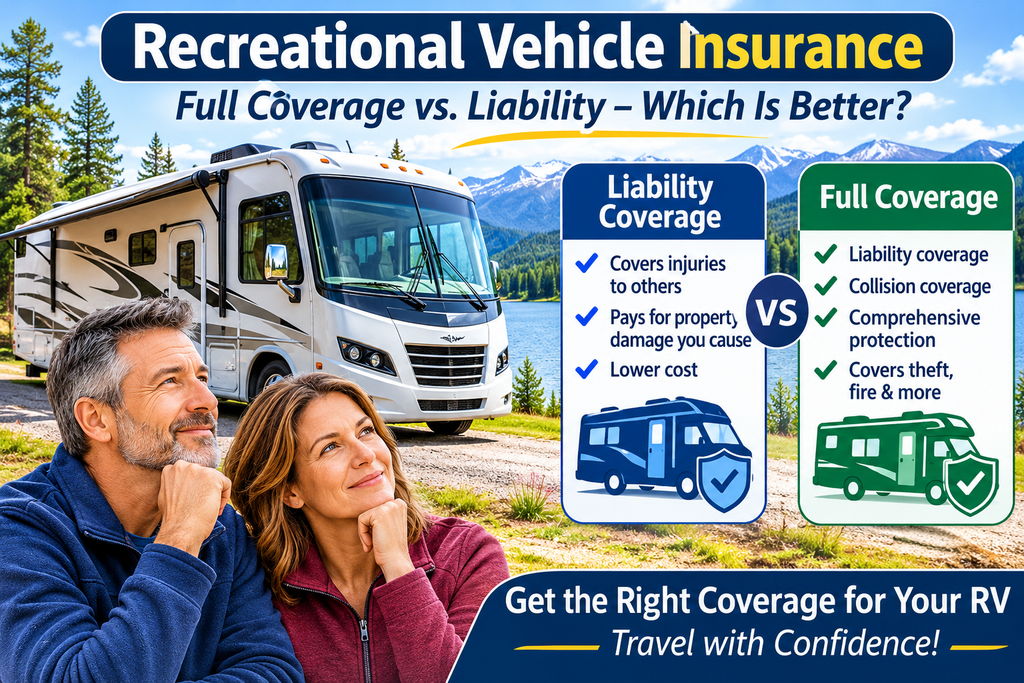
This means you may need to pay out of pocket for damage to your own vehicle.
2. What Is Full Coverage RV Insurance?
Full coverage RV insurance generally refers to a combination of liability, collision, and comprehensive coverage.
Although the term sounds like it covers every possible loss, full coverage does not mean unlimited protection. Your policy still has exclusions, deductibles, coverage limits, and conditions.
Its main components include:
Liability Coverage: Helps pay for covered injuries and property damage you cause to others.
Collision Coverage: Helps pay to repair or replace your RV after a covered collision, regardless of who caused the accident, subject to policy terms.
Comprehensive Coverage: Helps protect against covered non-collision events, including theft, fire, vandalism, hail, falling objects, and certain weather-related damage.
Additional RV Insurance Options
Depending on the insurer and policy, you may also consider:
- Roadside assistance: Helps with certain breakdowns, towing, and emergency roadside services.
- Personal belongings coverage: Protects eligible belongings stored inside your RV.
- Vacation liability: Provides certain liability protection while your RV is parked and used as a temporary residence.
- Full-timer coverage: Offers additional protection designed for people who use their RV as their primary residence.
- Emergency expense coverage: May help pay for temporary accommodation and transportation after a covered loss.
- Total loss replacement: May replace an eligible RV with a new model or provide another specified benefit after a qualifying total loss.
These additional protections can be especially useful for people who frequently travel or live in their recreational vehicles.
3. Full Coverage vs. Liability RV Insurance: Key Differences
Understanding the differences between these insurance options can help you select the right level of protection.
| Coverage feature | Liability-only | Full coverage |
|---|---|---|
| Injuries to others | Yes, up to limits | Yes, up to limits |
| Damage to others’ property | Yes | Yes |
| Your RV collision damage | No | Yes, subject to deductible |
| Theft protection | No | Generally included through comprehensive |
| Fire damage | No | Generally included through comprehensive |
| Vandalism | No | Generally included through comprehensive |
| Hail and storm damage | No | Generally included through comprehensive |
| Roadside assistance | Optional | Optional |
| Personal belongings | Usually not included | May be added |
| Vacation liability | May be optional | May be available |
The exact protection depends on your insurance company, policy wording, and selected endorsements. Maryland Insurance Administration+2
4. How Much Does Full Coverage vs. Liability RV Insurance Cost?
The cost of RV insurance depends on several factors, including the vehicle’s value, location, driving history, coverage limits, and deductible.
Generally, liability-only insurance costs less because it does not include coverage for physical damage to your own RV.
Full coverage usually costs more because it includes collision and comprehensive protection.
Factors That Affect RV Insurance Premiums
1. RV Type
The cost of insuring a Class A motorhome may differ from the cost of insuring a Class B camper van or Class C motorhome. Travel trailers and fifth-wheel campers also have different insurance needs.
2. RV Age and Value
Newer and more expensive recreational vehicles may cost more to insure because repairs and replacements can be expensive.
3. Location
Insurance premiums can vary by state and ZIP code. Areas with higher accident rates, theft risks, severe weather, or expensive repair costs may have higher premiums. Best Recreational vehicle insurance online
4. Driving History
A history of accidents, traffic violations, or insurance claims may increase your premium.
5. Coverage Limits
Higher liability limits and additional coverage options generally increase policy costs.
6. Deductible Amount
Choosing a higher deductible may reduce your premium, but you will have to pay more out of pocket when filing a covered claim.
7. RV Usage
An RV used occasionally for vacations may have different insurance requirements and pricing from one used as a full-time residence.Maryland Insurance Administration+2
5. Advantages and Disadvantages of Liability-Only RV Insurance
Liability-only insurance can be a practical option for some RV owners, but it is important to understand its limitations.
Advantages
- Lower insurance premiums.
- Provides protection against covered third-party claims.
- Can help meet state financial responsibility requirements.
- May be suitable for older RVs with limited market value.
- Allows owners to spend less on insurance when they can afford to cover their own vehicle damage.
Disadvantages
- Does not pay for damage to your own RV.
- Does not generally protect against theft.
- Does not cover your RV’s fire or weather damage.
- You may face significant repair expenses after an accident.
- May not meet financing or leasing requirements.
Liability-only insurance is most appropriate when you understand the financial risks and can afford to repair or replace your recreational vehicle yourself.
6. Advantages and Disadvantages of Full Coverage RV Insurance
Full coverage offers broader financial protection, particularly for expensive recreational vehicles.
Advantages
- Helps pay for covered collision damage to your RV.
- Provides protection against covered theft and vandalism.
- Covers certain fire, storm, and weather-related losses.
- Offers greater financial security for newer and valuable RVs.
- May satisfy lender or leasing company requirements.
- Can be combined with additional RV-specific coverage.
Disadvantages
- Higher premiums than liability-only insurance.
- Requires deductibles for applicable claims.
- Certain losses may be excluded.
- Older RVs may not justify the additional premium.
- Coverage limits may not fully cover the replacement cost of your RV.
Full coverage can be particularly valuable if you depend on your RV for frequent travel or full-time living.
7. Which RV Insurance Is Better for Different Types of Owners?
The best insurance option depends on your recreational vehicle, financial situation, and how frequently you use it.
New RV Owners
Full coverage is generally worth considering because a newer RV can represent a substantial financial investment.
Owners of Older RVs
Liability-only coverage may be reasonable if the RV has a low market value and you can afford potential repairs or replacement.
Occasional Vacation Travelers
Consider comprehensive and collision protection if your trailer or motorhome would be expensive to replace.
Full-Time RV Residents
Consider a specialized full-timer policy with personal liability, personal belongings, and other residence-related protections.
Travel Trailer Owners
Check what your towing vehicle’s liability policy covers. Separate physical damage coverage may be needed to protect the trailer itself.Maryland Insurance Administration+2
8. Is Full Coverage RV Insurance Required by Law?
In most states, liability insurance is required for motorized recreational vehicles that operate on public roads. However, the exact requirements depend on state law and vehicle classification.
Comprehensive and collision coverage are generally not legally required, but lenders and leasing companies may require them as a condition of financing.
Travel trailers and fifth-wheel campers may have different requirements because they are towed rather than self-propelled.
For example, Texas explains that liability coverage for a travel trailer may extend from the towing vehicle, while separate coverage may be needed to protect the trailer itself. Texas Department of Insurance+1
Before purchasing a policy, check your state’s insurance requirements and your loan or lease agreement.
9. How to Choose the Best RV Insurance Policy
Selecting an appropriate RV insurance policy requires comparing more than just monthly premiums.
Here are some practical steps:
- Evaluate your RV’s value: Determine how much it would cost to repair or replace your vehicle.
- Understand your financial situation: Consider whether you could afford a major repair without insurance.
- Compare insurance quotes: Request quotes from multiple companies with similar coverage limits.
- Review deductibles: Make sure you can comfortably afford the deductible.
- Check additional coverage: Look into roadside assistance, personal effects, emergency expenses, and vacation liability.
- Understand exclusions: Review what the policy does not cover, including certain water damage, wear and tear, and maintenance-related problems.
- Consider your travel habits: Choose coverage that reflects whether you travel occasionally or live in your RV.
- Check customer service: Research the insurer’s claims process and customer feedback.
Important RV Insurance Coverage Considerations
Before purchasing coverage, ask your insurer these questions:
- Does the policy cover my RV while it is parked or stored?
- Does comprehensive insurance cover flood and storm damage?
- Are personal belongings covered?
- Does the policy include emergency towing?
- Is there coverage for temporary accommodation?
- What happens if my RV is declared a total loss?
- Does my policy cover full-time RV living?
Getting clear answers can help prevent unexpected expenses when filing a claim.
10. Can You Switch From Liability-Only to Full Coverage RV Insurance?
Yes. In many cases, you can upgrade your RV insurance policy from liability-only to full coverage by adding comprehensive and collision protection.
However, the insurer may need to inspect the vehicle or verify its condition before approving the change.
Before upgrading, consider:
- The current market value of your RV.
- The cost of adding comprehensive and collision coverage.
- Your existing deductible.
- Whether your RV is financed.
- Whether additional coverage is available for personal belongings and emergency expenses.
If your RV’s value is significant, upgrading may provide valuable financial protection.
Frequently Asked Questions (FAQs)
1. Is full coverage better than liability-only RV insurance?
Full coverage generally offers broader financial protection because it includes collision and comprehensive coverage in addition to liability. Liability-only insurance may be sufficient for older, lower-value RVs when the owner can afford repairs or replacement.
2. Does liability-only RV insurance cover my own vehicle?
No. Liability-only coverage generally pays for covered injuries and property damage you cause to others. It does not pay to repair your own RV.
3. Does full coverage RV insurance cover theft?
Generally, yes. Comprehensive coverage can help pay for a stolen RV, subject to your policy limits, deductible, and conditions.
4. Is RV insurance required in every state?
Requirements vary by state and RV type. Motorhomes generally need liability insurance to operate legally on public roads. Towable RVs may have different requirements.
5. Does car insurance cover a travel trailer?
Your towing vehicle’s auto liability coverage may extend to certain accidents involving a travel trailer. However, it generally does not cover physical damage to the trailer itself. Check your policy and consider separate trailer coverage.
6. Does full coverage RV insurance cover natural disasters?
Comprehensive coverage may cover certain natural disaster damage, including damage from storms, hail, falling objects, and fire. Flood coverage and other exclusions depend on the policy.
7. Can I get RV insurance for an older motorhome?
Yes. Many insurers offer coverage for older motorhomes. Your premium and available coverage options will depend on the vehicle’s condition, value, age, and intended use.
8. Does full-time RV living require special insurance?
Full-time RV residents should consider specialized full-timer coverage. This can provide additional personal liability and personal property protection designed for people who use their RV as their primary residence.
9. Can I lower my RV insurance premiums?
Yes. You may reduce premiums by comparing quotes, choosing an appropriate deductible, maintaining a good driving record, asking about available discounts, and selecting coverage that matches your RV’s value.
10. Should I keep full coverage on an older RV?
It depends on the RV’s current value, repair costs, and your financial situation. If the annual cost of comprehensive and collision coverage is high compared with the RV’s value, liability-only coverage may be worth considering.
Conclusion: Which RV Insurance Should You Choose?
Choosing between full coverage and liability-only recreational vehicle insurance depends on your vehicle’s value, budget, travel frequency, and financial risk tolerance.
Liability-only insurance can be a cost-effective option for owners of older RVs who can afford to pay for their own vehicle repairs. However, full coverage offers broader protection against covered accidents, theft, fire, vandalism, and weather-related damage.
For newer, expensive, financed, or frequently used recreational vehicles, full coverage is generally worth considering. Before making a decision, compare multiple insurance quotes, review policy exclusions, and select coverage that protects your investment without exceeding your budget.