
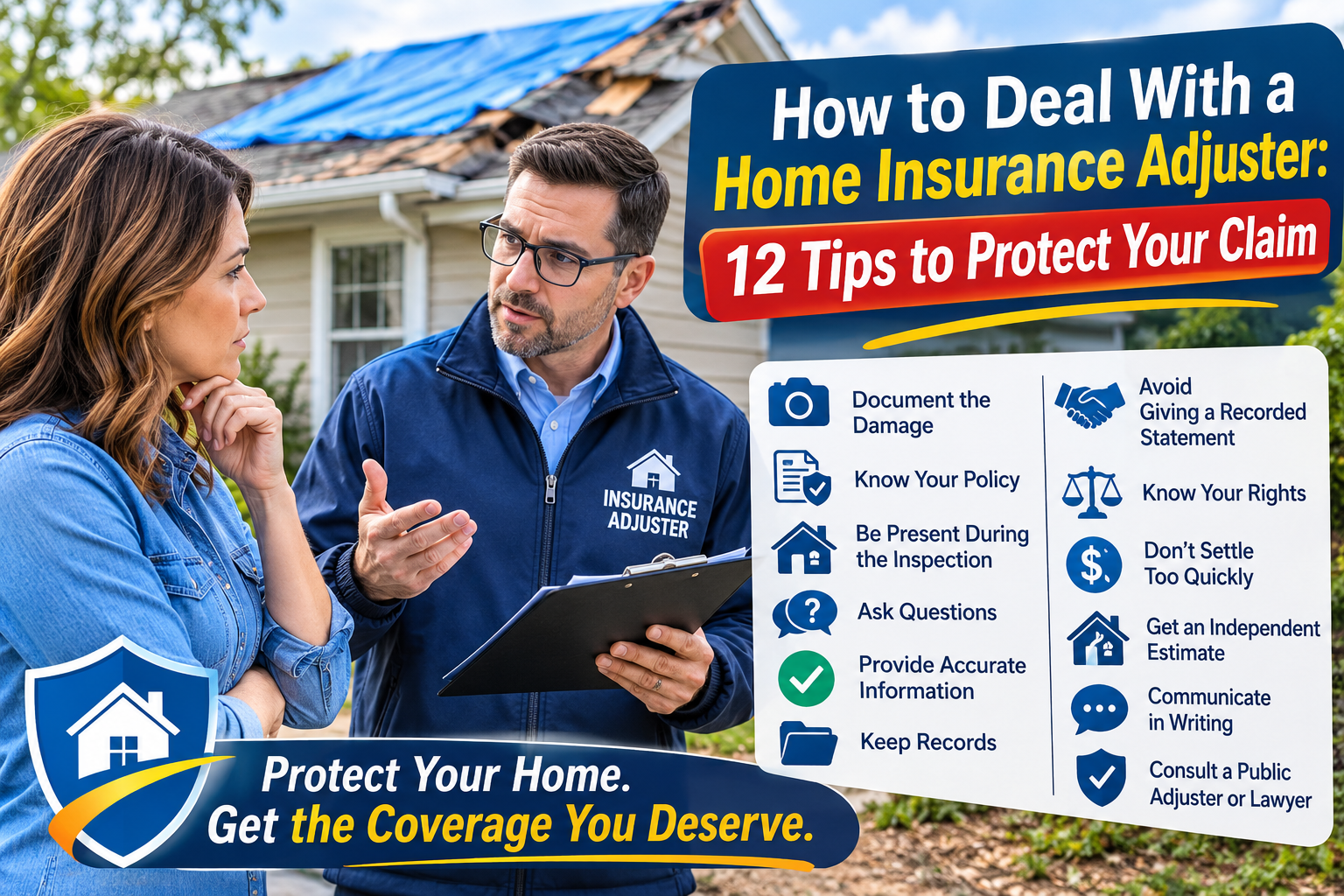
Dealing with property damage is stressful, especially when you must file a homeowners insurance claim and work with an insurance adjuster. Whether your home has suffered damage from a storm, fire, water leak, hail, or another unexpected event, getting a fair insurance settlement is important for covering repair costs and replacing damaged belongings.
A home insurance adjuster plays an important role in this process. The adjuster investigates the damage, reviews your insurance policy, examines supporting documents, and helps determine how much the insurance company should pay.
However, the first estimate does not always include every repair expense or identify all hidden damage. Missing documentation, overlooked repairs, and misunderstandings about policy coverage can affect your final settlement.
Knowing how to deal with a home insurance adjuster can help you protect your interests, communicate effectively, and avoid common mistakes throughout the claims process.
In this guide, we cover 12 practical tips to help you prepare for an inspection, document property damage, review settlement offers, and work toward a fair insurance claim resolution.
What Does a Home Insurance Adjuster Do?
A home insurance adjuster evaluates property damage after a homeowner files an insurance claim. The adjuster’s responsibility is to investigate the incident, assess the damage, review relevant policy provisions, and prepare an estimate for the insurance company.
Depending on the claim, an adjuster may:
- Inspect damaged areas inside and outside your home.
- Photograph and document visible damage.
- Review repair estimates and supporting documents.
- Examine damaged personal belongings.
- Investigate the reported cause of the loss.
- Communicate with contractors and other professionals.
- Prepare an estimate of covered repair or replacement costs.
- Identify applicable deductibles, coverage limits, and exclusions.
There are three common types of insurance adjusters.
Company adjusters: These professionals work directly for an insurance company and handle claims on its behalf.
Independent adjusters: Insurance companies hire these professionals as contractors to investigate and evaluate claims.
Public adjusters: These professionals represent policyholders rather than insurance companies. Homeowners may hire them to prepare, document, and negotiate insurance claims. Their services generally involve a fee, and licensing requirements vary by state.
Understanding who you are dealing with helps you know their responsibilities and your options throughout the claims process.
12 Tips on How to Deal With a Home Insurance Adjuster
1. Understand Your Homeowners Insurance Policy Before the Inspection
Before meeting with the insurance adjuster, take time to review your homeowners insurance policy.
Your policy explains which types of damage are covered, which situations are excluded, and how the insurance company calculates payments. Understanding these details helps you have more productive conversations with the adjuster.
Pay particular attention to:
- Dwelling coverage: Protection for the physical structure of your home.
- Other structures coverage: Protection for detached garages, fences, and sheds.
- Personal property coverage: Protection for furniture, electronics, clothing, and other belongings.
- Additional living expenses (ALE): Coverage for certain temporary housing and increased living costs when a covered loss makes your home uninhabitable.
- Deductibles: The amount you must pay toward a covered loss.
- Coverage limits: The maximum amount available under specific policy provisions.
- Exclusions: Situations or types of damage that your policy does not cover.
You should also understand whether your policy provides replacement cost value or actual cash value coverage.
Replacement cost coverage generally pays the reasonable cost to repair or replace covered property without deducting depreciation, subject to policy terms and limits. Actual cash value typically accounts for depreciation.
For example, if a damaged roof requires replacement, the settlement calculation may differ depending on your coverage type.
Practical tip: If you do not understand a particular policy provision, ask your insurance agent or claims representative to explain it before accepting an estimate.
2. Document All Property Damage Before Making Repairs
Documentation is one of the most important parts of a successful homeowners insurance claim.
Before cleaning up damaged areas or removing belongings, photograph and record everything you can safely access.
Take clear photographs and videos showing:
- Damaged ceilings and walls.
- Roof damage and missing shingles.
- Broken windows and doors.
- Water damage and visible mold.
- Damaged flooring and carpets.
- Fire and smoke damage.
- Damaged furniture and household appliances.
- Exterior damage to garages, fences, and other structures.
Take both wide-angle photographs and close-up images. Wide shots show the overall condition of a room, while close-ups capture specific damage.
If possible, record videos while walking through each affected area. Explain what happened and identify the damaged items.
Keep original photographs and videos whenever possible. Avoid editing the original evidence.
Remember that some damage may not be immediately visible. Water can travel behind walls, damage insulation, and affect flooring underneath carpets.
If additional damage is discovered during the repair process, document it and notify your insurance company.
Important: Your safety comes first. Do not enter structurally unsafe areas or touch damaged electrical equipment to obtain photographs.
3. Prepare a Detailed Inventory of Damaged Belongings
A home insurance adjuster may ask you to provide an inventory of personal belongings damaged or destroyed during the incident.
Instead of relying on memory during the inspection, prepare a detailed list beforehand.
Include information such as:
- Item name and description.
- Brand and model, if available.
- Approximate purchase date.
- Original purchase price.
- Estimated replacement cost.
- Condition before the incident.
- Description of the damage.
For example:
| Item | Purchase Price | Damage |
|---|---|---|
| LED television | $650 | Screen destroyed |
| Sofa | $1,200 | Water damage |
| Laptop | $900 | Fire and smoke damage |
| Refrigerator | $1,100 | Electrical damage |
Include photographs, purchase receipts, warranties, credit card statements, or online order confirmations when available.
If you no longer have receipts, do not assume that you cannot include an item in your claim. Previous photographs, product listings, bank statements, and other records may help establish ownership and value.
Be accurate when estimating prices. Never exaggerate the value of damaged belongings or include items that were not affected.
A complete inventory makes it easier for the adjuster to understand the extent of your personal property losses.
4. Be Present During the Adjuster’s Inspection
Whenever possible, arrange to be present when the insurance adjuster visits your property.
You know your home better than anyone else. You can point out areas that may not be immediately noticeable and explain how the damage occurred.
Before the inspection, prepare a checklist of affected rooms, structures, and belongings.
During the walkthrough:
- Show the adjuster every damaged area.
- Explain when and how you discovered the damage.
- Point out areas where water may have spread.
- Identify previous repairs or improvements when relevant.
- Show photographs taken immediately after the incident.
- Mention any temporary repairs already completed.
- Ask whether additional inspections are necessary.
Do not assume that the adjuster will automatically discover every problem.
For example, if a roof leak caused water to enter an attic and damage insulation, make sure the adjuster knows about the attic damage rather than focusing only on the ceiling stain.
Remain professional and cooperative throughout the inspection.
If the adjuster cannot inspect a particular area because of safety concerns or access restrictions, ask how that damage can be evaluated later.
5. Communicate Clearly and Keep a Record of Every Conversation
Good communication can make the insurance claims process easier and help prevent misunderstandings.
Whenever you speak with an insurance adjuster, explain the situation using accurate information. Avoid guessing about the cause of damage, repair costs, or the exact time an incident occurred if you are unsure.
If you do not know an answer, it is perfectly acceptable to say that you need to check your records.
Keep a claim communication log containing:
- Date and time of each conversation.
- Adjuster’s name and contact information.
- Claim reference number.
- Questions discussed.
- Documents requested.
- Information provided.
- Agreed follow-up actions.
- Expected response dates.
Whenever possible, communicate important matters through email.
If you discuss something important over the phone, consider sending a short follow-up email summarizing the conversation.
For example:
“Thank you for speaking with me today about my property damage claim. As discussed, I will provide the additional photographs and contractor estimate by Friday. Please let me know if any other documentation is required.”
This creates a written record that you can reference if questions arise later.
6. Get Independent Repair Estimates From Qualified Contractors
Do not rely entirely on the insurance adjuster’s estimate when evaluating the cost of repairing your home.
Consider obtaining an independent estimate from a qualified, licensed contractor where required by state law.
A contractor may identify repair requirements that were overlooked during the initial inspection.
For example, a contractor inspecting storm damage may discover:
- Additional roof repairs.
- Damaged roof decking.
- Wet insulation.
- Hidden water damage.
- Damaged electrical components.
- Required material replacements.
- Labor and disposal costs missing from the original estimate.
Ask the contractor to provide an itemized estimate explaining the work required and associated costs.
Compare this estimate with the insurance adjuster’s report.
If there are differences, ask the adjuster to review them. Provide photographs, measurements, contractor notes, and other supporting documents.
Keep in mind that an insurance company is not automatically required to accept a contractor’s estimate. The final decision depends on the policy, the evidence, and applicable insurance regulations.
Also, avoid signing agreements that transfer your insurance benefits or give a contractor control over your claim without fully understanding the legal and financial consequences.
7. Never Guess or Exaggerate the Extent of Damage
Honesty is essential when dealing with a home insurance adjuster.
You should report all damage, even if you are uncertain whether it is covered. However, avoid making statements that you cannot support.
For example, do not claim that a particular appliance stopped working because of a storm unless you have a reasonable basis for connecting the damage to that event.
Similarly, do not inflate repair costs, invent damaged belongings, or submit inaccurate purchase prices.
Insurance companies may investigate claims by reviewing photographs, repair records, inspection reports, and other evidence.
Inaccurate information can delay your claim, create disputes, or potentially result in serious consequences, including denial of coverage or allegations of insurance fraud.
If you discover additional damage after your initial report, contact your insurance company and explain what you found.
You do not need to have every answer during the first inspection. You do need to provide accurate information and cooperate with reasonable requests.
8. Ask for an Itemized Insurance Adjuster’s Estimate
When the insurance adjuster completes the inspection, ask for a copy of the written estimate or other claim evaluation documents available under your state’s rules and your policy.
An itemized estimate is more useful than a single total payment figure because it explains how the insurer calculated the proposed repair costs.
Review the estimate carefully.
Look for:
- Missing rooms or damaged areas.
- Incorrect measurements.
- Missing materials.
- Incomplete labor costs.
- Incorrect material quality.
- Missing removal and disposal costs.
- Overlooked building code requirements where coverage applies.
- Incorrect depreciation calculations.
- Deductible adjustments.
For example, if the adjuster estimates that replacing damaged flooring will cost $2,000 but your contractor identifies additional work involving subfloor repairs, ask for an explanation of why those repairs are missing.
Do not assume that every difference means the adjuster made a mistake. There may be legitimate differences in scope, pricing, policy coverage, or repair methods.
Ask specific questions and request written explanations when necessary.
A clear, itemized estimate gives you a stronger basis for discussing disagreements.
9. Understand Your Deductible and Depreciation
Before agreeing to a settlement, understand how your deductible and depreciation affect the payment.
A deductible is the amount you are responsible for paying toward a covered loss.
For example, suppose your covered repair costs are estimated at $15,000 and your deductible is $2,000.
The initial calculation may look like this:
- Estimated covered damage: $15,000
- Insurance deductible: $2,000
- Potential payment: $13,000
However, the actual payment may be different if your policy includes depreciation or other applicable limits.
Under replacement cost policies, the insurer may initially issue an actual cash value payment and release recoverable depreciation after you complete eligible repairs and provide the required documentation.
For example:
- Replacement cost estimate: $15,000
- Depreciation: $3,000
- Actual cash value: $12,000
- Deductible: $2,000
- Initial payment: $10,000
If the policy allows recovery of the withheld depreciation, you may receive additional payment after satisfying the policy requirements.
Ask the adjuster:
- Is the estimate based on replacement cost or actual cash value?
- How much depreciation has been deducted?
- Is the depreciation recoverable?
- What documents are required to receive additional payment?
- Are there deadlines for completing repairs?
Understanding these calculations helps you avoid confusion when you receive the first insurance payment.
10. Do Not Feel Pressured to Accept a Settlement Immediately
After a property inspection, the insurance company may provide a settlement offer.
Although receiving an offer can feel like progress, do not rush into accepting it without reviewing the details.
Compare the settlement with:
- Your policy coverage.
- The adjuster’s estimate.
- Contractor repair estimates.
- Your photographs and damage inventory.
- Any additional inspection reports.
If something appears incomplete, ask questions before agreeing to a final settlement.
Be especially careful with documents that contain release language or state that payment represents a full and final settlement.
An initial payment, emergency advance, or undisputed payment is not necessarily the same as a final settlement.
You should understand what you are signing and whether accepting the payment affects your ability to pursue additional covered costs.
If you are uncertain about the legal effect of a settlement agreement, consider consulting an attorney who handles property insurance claims.
Remember that claim deadlines, proof-of-loss requirements, and other policy obligations may continue to apply while you review an offer.
11. Know How to Dispute an Unfair or Incomplete Settlement
Sometimes, homeowners disagree with an adjuster’s findings or believe the insurance company has underestimated the damage.
If this happens, approach the disagreement professionally and provide evidence.
Start by identifying the specific items you believe are missing or incorrectly evaluated.
For example:
- The adjuster overlooked damage in one room.
- The repair estimate does not include necessary materials.
- The contractor identified additional structural damage.
- The depreciation calculation appears incorrect.
- The insurance company denied coverage without explaining the relevant policy provision.
Submit a written explanation along with supporting photographs, repair estimates, invoices, or professional reports.
If the adjuster cannot resolve the disagreement, request a review by the claims supervisor or claims manager.
You may also have additional options depending on your policy and state law.
Request an appraisal: Some homeowners insurance policies include an appraisal provision for disputes over the amount of a loss. The process generally involves each party selecting an appraiser, with an umpire potentially resolving differences. Check your policy carefully because appraisal procedures and their scope vary.
Hire a public adjuster: A licensed public adjuster can review your policy, document damage, prepare a claim, and negotiate with the insurer on your behalf. Ask about fees, licensing, and the terms of the agreement before hiring one.
Consult an attorney: If you believe your insurer has improperly denied coverage, delayed the claim, or failed to honor policy obligations, an experienced insurance attorney may help explain your legal options.
Contact your state insurance department: State insurance regulators offer consumer assistance and may investigate complaints involving insurance companies.
Do not assume that every low settlement is unfair. Focus on identifying specific differences and supporting your position with reliable evidence.
12. Keep All Documents Until Your Claim Is Fully Resolved
The final step is maintaining an organized record of your entire insurance claim.
Even after receiving an initial payment, additional documentation may be required before the claim is completely resolved.
Create a dedicated digital folder and save copies of:
- Your homeowners insurance policy.
- Insurance claim confirmation.
- Adjuster’s inspection report.
- Photographs and videos.
- Contractor estimates.
- Repair invoices.
- Receipts for temporary repairs.
- Personal property inventory.
- Emails and letters.
- Payment records.
- Proof-of-loss forms.
- Settlement agreements.
- Additional inspection reports.
Keep records of temporary living expenses if you are eligible for Additional Living Expenses coverage.
These may include hotel bills, certain additional meal costs, temporary rental expenses, and other eligible expenses resulting from a covered loss.
Check your policy for applicable limits and documentation requirements.
Do not throw away damaged belongings before documenting them and giving the insurance company a reasonable opportunity to inspect them, unless safety, sanitation, or other urgent circumstances require removal.
Organized documentation makes it easier to answer questions, provide missing information, and resolve disagreements.
Common Mistakes to Avoid When Dealing With a Home Insurance Adjuster
Even when homeowners have legitimate insurance claims, certain mistakes can make the process more difficult.
Here are some common mistakes to avoid:
Making permanent repairs before documenting the damage: Take photographs and videos before removing damaged materials whenever it is safe to do so. Emergency repairs may be necessary, but preserve evidence and keep receipts.
Failing to report additional damage: If contractors discover hidden damage during repairs, notify the insurance company promptly and follow the policy’s reporting requirements.
Accepting an estimate without reviewing it: Always check whether the estimate includes all affected areas and necessary repair work.
Throwing away damaged belongings too early: Preserve damaged property for inspection when practical and safe.
Ignoring insurance company deadlines: Review your policy and all claim correspondence for deadlines involving proof of loss, documentation, repairs, and other requirements.
Relying only on verbal communication: Important conversations and agreements should be documented in writing whenever possible.
Signing documents without understanding them: Carefully review settlement releases, contractor agreements, and assignments of benefits before signing.
Avoiding these mistakes can help you maintain a stronger and more organized claim.
What Should You Do If a Home Insurance Adjuster Denies Your Claim?
A claim denial does not always mean that you have no further options.
Start by requesting a written explanation of the insurance company’s decision.
The explanation should identify the relevant policy provisions and clarify why the insurer believes the reported damage is not covered.
Review the denial carefully and compare it with your policy.
You may need additional evidence, such as:
- Independent inspection reports.
- Contractor assessments.
- Photographs and videos.
- Repair invoices.
- Expert opinions.
- Records showing when the damage occurred.
If you believe the insurer misunderstood the circumstances or overlooked important evidence, submit a written appeal or request reconsideration through the company’s claims process.
You can also escalate the matter to a claims supervisor or contact your state department of insurance.
If the dispute involves complicated coverage questions or substantial property damage, consider speaking with a qualified insurance attorney.
Act promptly because policy deadlines and state-specific legal time limits may restrict how long you have to challenge a decision.
Frequently Asked Questions (FAQs)
1. Should I be present when the home insurance adjuster visits?
Yes. Being present allows you to explain how the damage occurred, identify affected areas, and provide supporting photographs or documents. You can also ask questions about the inspection and clarify any concerns.
2. What should I not say to a home insurance adjuster?
Avoid guessing about the cause of damage, exaggerating losses, or making unsupported statements about repair costs. Provide accurate information and explain when you are unsure about something.
You should also avoid agreeing to settlement terms before understanding their financial and legal implications.
3. Can I hire my own contractor to inspect home damage?
Yes. You can generally hire a qualified contractor to evaluate the damage and prepare an independent repair estimate. This estimate can help identify missing items or differences in repair scope when compared with the insurer’s estimate.
4. What happens if the insurance adjuster’s estimate is too low?
Request an itemized explanation and identify the specific items you believe were overlooked or underestimated. Submit supporting contractor estimates, photographs, and other relevant evidence.
If the disagreement continues, consider escalating the matter to a claims supervisor, reviewing your policy’s appraisal provision, hiring a public adjuster, or consulting an attorney.
5. Does a home insurance adjuster work for me or the insurance company?
A company adjuster works for the insurance company, while an independent adjuster is generally hired by the insurer to evaluate claims.
A public adjuster represents the policyholder and may be hired to prepare and negotiate the claim on the homeowner’s behalf.
6. How long does a home insurance adjuster take to settle a claim?
The timeline varies depending on the severity of the damage, policy requirements, investigation, availability of documentation, and applicable state regulations.
A straightforward claim may be resolved relatively quickly, while major storm, fire, or structural damage claims can take considerably longer.
Ask your insurance company for an expected timeline and keep track of any outstanding requests.
7. Can I dispute a home insurance settlement?
Yes. If you believe the insurance company has underestimated your covered losses, you can submit supporting documentation and request a review.
Depending on your policy and state law, you may also have access to appraisal, mediation, regulatory complaint procedures, or legal action.
Final Thoughts
Dealing with a home insurance adjuster does not have to be overwhelming. The key is to understand your policy, document all damage, communicate professionally, and review every estimate before agreeing to settlement terms.
Remember that the first inspection may not reveal every problem, particularly when water, fire, or structural damage affects areas that are difficult to access.
Take photographs, prepare a detailed inventory, obtain independent repair estimates when appropriate, and keep written records of important conversations.
If you disagree with the adjuster’s findings, do not simply accept an incomplete estimate. Ask questions, provide supporting evidence, and explore the options available under your policy and state law.
Most importantly, stay organized and protect your rights throughout the process. A well-documented claim and informed approach can help you work toward a fair insurance settlement and move forward with repairing your home.
Disclaimer: This article provides general educational information about homeowners insurance claims in the United States. Insurance policies, state laws, deadlines, and claim procedures vary. Review your individual policy and consult a qualified insurance professional or attorney for advice about your specific situation.